Showing posts with label Hiking. Show all posts

Sunday, October 1, 2023

Salt Mine and Hiking Tour, Romania

On Saturday we took an all-day tour to see some of the sights near Cluj.  It was a full day, with just us, another couple, and our guide Tudor.

We started off at the Turda Salt Mine about 35 km (21 miles) from Cluj.


Table salt was continuously produced here from the Middle Ages until 1932.  It reopened in 1992 as a salt therapy centre.  It was renovated in 2008 and opened for tourists in 2010.

There's an underground layyrinth carved out of salt, numerous chambers with historic mining equipment, and an underground lake to explore.  


Less of a salt mine and more of an underground theme park.  There's a Ferris wheel, miniature golf, table tennis, bowling, and boats to keep people entertained. 


After the salt mine we headed to Cheile Turzii, the Turda Gorge about 30 minutes away.  


The Turda Gorge is a 3 kilometre limestone canyon that's home to 1000 plant and animal species.  There are caves here that were inhabited since Neolithic times.

We spend about two hours doing a 9 kilometre (5.5 mile) hike.  The views were lovely and it felt good to do some hiking.

After our hike we visited a small village called Rimetea which used to be an important mining town. 

Rimetea has been inhabited since Roman times and is now home to about 1000 people.  

Although a Romanian village, the population is about 85% ethnic Hungarian.  In Hungarian, the village is called Torockó.


The former local administrative budding was built in 1889.  In 1952 it became an ethnographical museum.


The Orthodox Monastery of the Holy Archangels Michael, Gabriel, and Raphael was built in 1933.


The interior was absolutely stunning.  Well worth a visit.

Saturday, September 30, 2023

Cluj-Napoca, Romania

Cluj-Napoca is located in northwest Romania.  It's about equidistant from BucharestBudapest, and Belgrade.  The city is home to about 287.000 people with over 410.000 in the greater metro area.  It's the country's second-largest city and the largest in Transylvania.  


While the city is officially Cluj-Napoca everyone just calls it "Cluj."  The city dates back to 1213, and is located on the site of a pre-Roman settlement named Napoca.  In 1974, the communist government hyphenated the name to emphasise its Roman history.

In 2021, it was named a UNESCO City of Film and joined the UNESCO Creative Cities Network.

St. Michael's Church was completed in 1487 and it is named after the city's patron saint, the Archangel Michael.  It is the second-largest church in Transylvania.


The opera housed was completed in 1906.  Since 1919 the building has been home to both the local Romanian National Theatre and the Romanian Opera.  In 1920, the first two concerts were conducted by the Czech conductor Oskar Nebdal.

The Dormition of the Theotokos Cathedral is the Orthodox cathedral.  It was was consecrated in 1933.


The State Hungarian Theatre is also home to the Hungarian Opera.  The building was completed in 1910, and renovated in 1961, and is listed as a national historic monument.

The Palace of Justice was completed in 1902.


The Franciscan Church was consecrated in 1290.  It is a mix of Romanesque and Gothic styles with a Baroque tower.


The Matthias Corvinus House was built in 1443 and it's one of the oldest buildings in the city.  Over the years it has been a jail, a hospital and a museum.  Since 1950, it has been a visual arts institute of the local Art and Design University.

The Transfiguration Cathedral was consecrated in 1803.  It is known as the Minorites' Church and in 1924, the Vatican donated it to the Romanian Greek-Catholic Church.


The Evangelical Church was consecrated in 1829.  It also serves the local German-speaking Lutheran community.

The Cathedral of the Martyrs and Confessors of the 20th Century is still under construction.  Work began in the early 1990s and there is no timeline on when it should be completed by.  It is financed by private donations and is expected to cost over €270M.


The House of the Army is functionalist building that serves as a cultural and social centre for both military personnel and the public.


The Central Park was founded in the 19th century.


The Jewish History Museum opened in 2020.


The Neolog Synagogue was completed in 1887.  It is also known as the Temple of the Deportees because Jews were sent from here to Auschwitz during WWII.


We also took a couple of local day trips to Sibiu, to a salt mine, as well as some hiking at the Turda Gorge.

Monday, July 31, 2023

Tatranská Lomnica, Slovakia

After getting back from our USA trip we spent three days with Kája's oldest sister and their father in the Tatras.  We took a couple of trains and met up with them in Tatranská Lomnica.  

Tatranská Lomnica is a small tourist town in northern Slovakia.  The town was founded in 1892 and is home to less than 1000 people.  It's about 345 km (215 miles) from Bratislava.

People come to Tatranská Lomnica to go hiking in the summer and skiing in the winter.  


We took a cable car up to Skalnaté pleso, which is a glacial lake located at an altitude of 1751 metres (5,744 feet).


The lake lies at the lowest point of the Rocky Valley that sits under the southern cliffs of Lomnické štít.  The lake has a depth of 4,2 metres (138 feet).

The Skalnaté pleso Observatory was founded in 1943.  It has two telescopes and caries out research about comets and asteroids.


From here, it's another cable car up to Lomnické sedlo which is 2190 metres (7,185 feet) above sea level. 


Here you can visit Lomnický štít which is the second-highest peak in the High Tatras.  

It's 2634 metres (8,642 feet) tall and it is the only peak int he Tatras that's accessible by cable car which were first put in between 1937-1940.


There are some really nice views of the mountains from up here.


In town there's a ski museum that opened in 2013.  It focuses on the history of winter sports in the Tatras up until 1945.

TANAP Museum, the Tatra National Park Museum, opened in 1957 in Poprad before moving to Tatranská Lomnica in 1959.  The museum moved to its current building in 1969.  Most of the exhibitions are about the local animals, flora and fauna found in the Tatras.  

We really enjoyed our visit to Tatranská Lomnica.  The Tatras were worth the wait.  I'm looking forward to our next visit.  

We also checked out nearby Štrbské Pleso.

Thursday, July 27, 2023

The Tatra Mountains

Tomorrow we're headed to Tatranská Lomnica, in the High Tatras, in northern Slovakia.  Visiting the Tatras has been on my list for a while so I'm looking forward to doing a bit of hiking.  We're going to meet his dad and sister who are already there.  I'm still not 100% over the jet lag from our USA trip but I'll manage.

The Tatras are the highest mountains in the Carpathians and form a natural border between Slovakia and Poland.  Many of the Rocky Mountains exceed 2000 metres (+6,500 feet) tall.  There are three main parts: the High Tatras, Belianské Tatras, and the Western Tatras.  

The Tatras take up 785 sq km (303 sq miles) with about 78% in Slovakia and about 22% in Poland.  The Tatras are basically the "Slovakian Alps" and a favourite place for hiking and skiing.  

The mountains were a problem for hikers back in the day because it was illegal to cross the border without going through an official border checkpoint and there weren't any checkpoints on the border ridge.  At least until 2007, when both Slovakia and Poland joined Schengen and internal border checks became a thing of the past.

There's a Tatra National Park in Slovakia and a Tatra National Park in Poland.  And both are part of the UNESCO World Network of Biosphere Reserves.

I hope that we survive.  Slovaks love to joke about Czechs getting lost, or needing to be rescued, in the Tatras.  Usually because Czechs took the wrong equipment, wrong clothes or wrong shoes.  One joke is that the world's biggest Czech cemetery, outside of Czechland, is called the High Tatras.

Sunday, August 15, 2021

Macocha Gorge

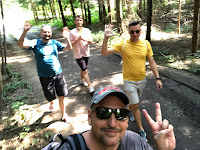
On Friday I made plans with Vašek, Aleš, and Michał to go hiking today.  We headed out to the Macocha Gorge, also known as the Macocha Abyss, which is about 20 km (12 miles) north of Brno.

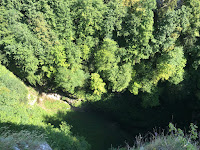
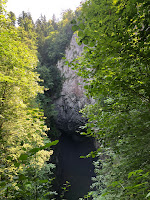
The gorge is a sinkhole in the Moravian Karst.  The last time I was at the karst was back in 2011


The gorge is about 174 metres (571 feet) long and 76 (249 feet) metres wide.  It was created when the ceiling of a huge cave hole fell in.  It is the deepest sinkhole of its kind, not only in Czechland but, in Central Europe.


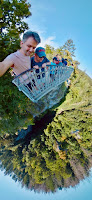
There's a viewing platform at the top that was built in 1882.  


There's also a second lower platform that was built in 1899 that is about 92 metres (302 feet) from the bottom.


The weather was great and it felt good to get out for some exercise.