Showing posts with label Northern Ireland. Show all posts

Tuesday, April 11, 2023

25th Anniversary of the Good Friday Agreement

Yesterday was the 675th anniversary of Charles University and it was also the 25th anniversary of the Good Friday Agreement.

The Good Friday Agreement, known also as the Belfast Agreement, signed on 10 April 1998, brought peace to Ireland.

The agreement was signed by the UK and Irish governments and was confirmed by referendums in both Ireland and Northern Ireland.  It allowed for devolved government in Belfast but more importantly, it brought an end to The Troubles which was the 30 years of violence between nationalists and unionists.

The Troubles began in the late 1960s as violent conflicts between Catholic Unionists and Protestant Loyalists.  During this time more than 3,500 people were killed and more than 50,000 injured.

The agreement acknowledged that the majority of people in Northern Ireland wanted to remain a part of the UK.  It also acknowledged that many people in Northern Ireland, and the majority in the Republic of Ireland want a united Ireland.  If and when a day comes that the majority of people in Northern Ireland want to be united with Ireland, then both the Irish and British governments must comply.

Everyone in Northern Ireland has the right to UK or Irish citizenship, or may have both passports.

Paramilitary gourds had to decommission weapons and the British and Irish governments committed to the early release of about 400 prisoners.  The British had to normalise security arrangements at the border.

One of the biggest problems of Brexit is that there's now a land border in Ireland between the UK and the EU.  Many people have been concerned that putting a hard border between Ireland and Northern Ireland could bring back the Troubles.

Here are a few videos I found on YouTube.

BBC News

RTÉ News

RTÉ News

Sunday, April 4, 2021

Erasmus

Brno is a student city and, under more normal times, there are many foreign students here under the Erasmus Programme.  Erasmus is the EU student exchange programme that was established in 1987.  It provides educational exchanges across the EU.  Some non-EU countries like Turkey, Iceland, Serbia, Norway, and Macedonia pay to participate in the programme as well.  Erasmus is the acronym for the EuRopean Community Action Scheme for the Mobility of University Students.  

In 2014, all of the EU's programmes for education, training, youth and sport were combined under Erasmus Plus.

Under Erasmus Plus students don't pay any more tuition than what they pay at their home institution.  Students receive grants to help cover living expenses to study abroad and for work placements/internships.  Teachers and educational staff are also able to attend training courses across Europe.  

Every year around 300.000 students participate in the programme at over 4.000 institutions in 37 countries.  Spain sends the most participants followed by France, Germany, and Italy.  The most popular receiving countries are Spain, Germany, Italy, and France.

I don't know how true it is but I've heard that some 25% of Erasmus participants meet their future spouse/partner while on the programme.

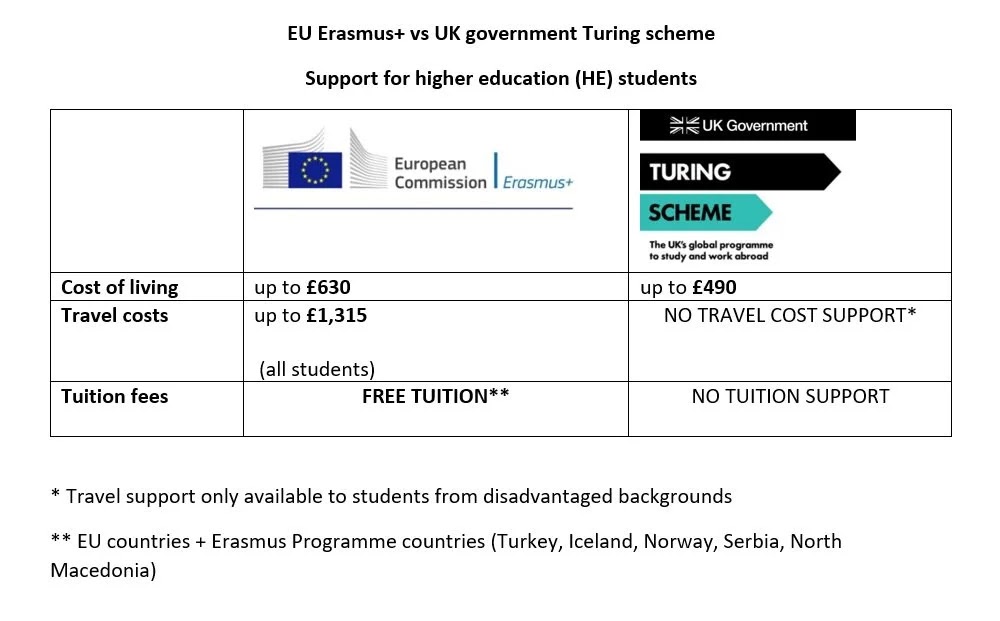
After Brexit the United Kingdom decided to no longer participate in Erasmus.  So UK students can no longer study in the EU and EU students aren't able to study at UK institutions.  The UK has rolled out the Turing Scheme, named after Alan Turing, as its replacement for Erasmus.  It will allow up to 35.000 UK students to study and work worldwide.   

Erasmus provides more money to students than Turing to subsidise their foreign placements.  

Ireland has announced that it will fund students from Northern Ireland to continue to participate in Erasmus even though the UK pulled out of the programme.

Tuesday, January 5, 2021

Post-Brexit EU Trade Deal

Thanks to Brexit, the UK is no longer part of the single customs union.  The UK and the EU did manage to agree on a last minute trade deal right before Christmas.  The impact of which is already starting to be felt and I believe that more problems will continue to pop up as Brexiters begin to realise the implications of voting to leave the EU.

The deal maintains the Good Friday peace deal so there is no hard border between Ireland and Northern Ireland.  In order to do this, Northern Ireland remains in the EU single market for goods, which means that Northern Ireland has to follow the EU's customs rules.  So now there's a customs border in the Irish Sea which basically separates the UK, between Northern Ireland and England/Scotland/Wales.

All goods moving between Great Britain and Northern Ireland now require a customs declaration, and additional certification on some goods and products, just as it does between the UK and any other EU-member country.

There's no more unlimited freedom to work and live between the UK and the EU.  UK citizens are free to visit Europe but have to follow the Schengen rules which means they can only be in the EU for up to 90 days in a 180-day period.  Any stay over 90 days will require a visa.

Not that there's a whole lot of travel now due to COVID-19 but when arriving in the EU, UK citizens no longer get to use the EU/EEA queues.  They have to use the non-EU citizen queues.

There are now additional customs duties, import fees and VAT when you purchase something online from the UK.  EU consumer protection rules no longer apply to purchases made from the UK.  So I won't be buying anything any longer from Amazon.co.uk.  I need to switch to Amazon in Germany

Mail will be more complicated.  Both from the UK to the EU and vice versa.  All customs fees, duties and taxes need to be paid in order to pick up any packages.  Some shipping companies have already increased their fees to cover the cost of the extra paperwork required.

The UK has set new tax rules where taxes must be collected at the point of sale which means that a business in the EU must collect taxes on sales made to UK customers which means a lot of tax headaches because now the EU firm must establish an account with the UK tax authorities and keep up with ever changing UK tax laws.  There are already cases where EU firms are no longer selling goods to UK customers.

I'm still not sure what's going to happen with surcharge-free roaming.  I have no idea what I'll pay to use my mobile whenever I actually make it back to the UK for a visit.

Booze cruises to the wine shops in Calais, France, were popular because there was an unlimited allowance on alcohol.  That comes to an end because now, there's a limit on the amount of alcohol allowed from the EU for personal consumption.  UK citizens can now only take back home up to 42 litres of beer, 18 litres of wine and 4 litres of spirits, plus up to 200 cigarettes.

On top of all of the this the UK still has to settle a £25 billion ($X) divorce bill by 2057.  It will be interesting to see what other unintended headaches pop up as a result of Brexit

Here are a few short videos already showing up on YouTube showing some of the consequences of the post-Brexit trade deals.

©Al Jazeera

©9 News Australia

©Sky News

There was speculation that with the UK out of the EU, that English would no longer be an official EU language.  Every country gets to put up an official language and Ireland chose Irish and Malta chose Maltese so now there's no EU country with English as its official language.  English is the most widely taught foreign language in the EU.  It appears that English will be kept on as an official EU language.

©Euronews

Update:  Here's a short story on Brexit's impact on the music industry.  I never even thought about this one.  What a mess.
©Euronews

Saturday, February 1, 2020

The UK Left the EU

Well Brexit finally happened.  Yesterday, after 47 years, the United Kingdom officially left the European Union

Now starts the transition period which will last until 31 December 2020. Everything should stay the same for the rest of the year.  

27 EU members minus the UK
The UK has to continue following EU laws and continue putting money in to the EU coffer.  The big difference is that the UK no longer gets to vote in the EU Parliament.

EU citizens are still allowed to live and work in the UK.  UK citizens can still live and work in the EU.  At least until the end of the year.  Then there need to be agreements on the rights of EU and UK citizens residing in each other's territory.  For example, what happens to all of the British who have bought homes and retired in Spain?

The UK and the EU will have to agree on a new trade deal.  Plus individual trade deals with the rest of the world.


The biggest sticking point is going to be the Irish border.  The Good Friday Agreement opened the border and put an end to the Troubles.  


During the Troubles there were only 20 border crossings between the Republic of Ireland and Northern Ireland.  Today there are 208 border crossings.

It's quite the mess.  The UK wanted to close its borders with the EU.  Now Northern Ireland is the new physical border between the UK and EU.  No one wants the Irish border closed or a return of the Troubles. 

Pre-Brexit vs My Future UK Prediction

Who knows what the end result will end up looking like?  Personally I think Brexit will result in the eventual breakup of the UK.  Eventually, the two Irelands are going to end up as a united Ireland.  Scotland voted to remain in the EU during the last referendum but they voted overwhelmingly to remain in the EU so it's just a matter of time before Scotland eventually leaves the UK.  The future UK will probably just be the United Kingdom of England and Wales.  This is just my personal opinion.  I don't have a crystal ball but this is what I'd bet on.

Tuesday, October 22, 2019

Marriage Equality in Northern Ireland

Northern Ireland finally joins England, Scotland, and Wales in allowing same-sex marriage in the United Kingdom.  This was the only part of the UK where it wasn't recognised.  The Republic of Ireland passed it in 2015 so now same-sex marriage will be legal across all of Ireland

Northern Ireland has allowed civil partnerships since 2005 but that doesn't give same-sex couples the same rights and responsibilities as a civil marriage.

It's been a long road in Northern Ireland.  Same-sex marriage was voted on five times between 2012 and 2015 and even though it narrowly passed on the fifth attempt it was vetoed by the Democratic Unionist Party.  

It will be law in January 2020 and on Valentine's Day, 14 February 2020, the first marriages may be registered.

Thursday, May 18, 2017

New Quid

The Euro isn't the only currency being refreshed in Europe.  Last September, the Bank of England released a brand new fiver in the United Kingdom.

Old £5 above, new £5 below
The new £5 bank note is made from polymer so it is plastic.  The new bill has enhanced security features which makes it harder to counterfeit.  The plastic bill is expected to last at least 2,5 times longer than the old paper notes.

Back side of the new fiver
People had until midnight on 5 May 2017 to spend their old paper £5 notes before they went out of circulation.  Scotland and Northern Ireland print their own bank notes so I assume that they also have new polymer £5 notes but I haven't seen them.

A new £10 note will be released in September.  The new £20 note is scheduled for 2020.

Here's a short YouTube video about the new fiver.

©Bank of England

Front side - new £1 on left, old £1 on right
Then on 28 March 2017 a new £1 coin was released.  The new 12-sided coin is supposed to be the world's most secure coin.
Back side - new £1 on left, old £1 on right
The old "round pound" will no longer be legal tender on 15 October 2017.  I need to check to see how many old coins I still have.
Here's another YouTube video, this one about the new coin.

©The Royal Mint

Update:  Here's the new £10 bank note.
Update:  Here's the new £20 and £50.

Saturday, November 5, 2016

My First Bonfire Night

Tonight was my first Bonfire Night.  It's also known as Guy Fawkes Night and it is celebrated every 5th of November.

Quick history lesson...Catholics were persecuted under Elizabeth I's rule for 45 years.  Many had hoped that when Protestant King James I ascended the British throne that they would be free to practice their religion.

When that didn't happen, in 1605, a group of Catholic conspirators planned to assassinate the King and blow up the house of Parliament.


The assassination attempt failed and Guy Fawkes, one of the conspirators of the Gun Powder Plot, was executed with his co-conspirators.  So every 5th of November, there's a celebration to commemorate the failed attempt.


Remember, remember!
The fifth of November,
The Gunpowder treason and plot;
I know of no reason
Why the Gunpowder treason
Should ever be forgot!

Many communities across the United Kingdom have fireworks and a bonfire where an effigy of Guy Fawkes is burned.  In Northern Ireland, bonfires aren't held in Catholic neighbourhoods; just the Protestant ones.

The celebration was exported to many British colonies.  In New England, it pretty much ended with the American Revolution.  It is still celebrated in New Zealand, South Africa, and parts of Canada.

We decided to drive out in search of Auckland fireworks but didn't have a lot of success.  We ended up at the beach by Devenport and watched people light fireworks.  We loaded a German immigrant a lighter for his daughter's sparklers and she gave each of us a sparkler.  It was very sweet.

Here's a video I found on YouTube that talks about Guy Fawkes Night.

©Anglophenia

Friday, June 24, 2016

Brexit Results

Wow!  This whole Brexit thing has me absolutely gobsmacked.  I can't believe how the vote went.

The final results were 52% for the United Kingdom to leave the European Union vs 48% to remain.  Again, absolutely gobsmacked.


I've heard arguments that a post-Brexit UK could leave the EU and still retain benefits like the four countries in the European Economic Area.  To me, this just sounds dumb because the UK would then still have all of the obligations it currently does but it would lose its vote.  Staying the same without having a say doesn't seem too bright to me.  Just saying...

The overall vote was close but it wasn't close across the entire UK.  The majority of England and Wales (except for their capitals of London and Cardiff) voted to leave.  The majority of Scotland and Northern Ireland voted to remain.  Could this lead to another independence referendum in Scotland?  Does this mean that the Common Travel Area will be impacted and border checks will have to be reintroduced between Ireland and Northern Ireland?  Could there be a referendum for Northern Ireland to leave the UK and join the Republic?  

Residents of the British Territory of Gibraltar voted overwhelmingly to remain in the EU.  Brexit could have serious political and economic consequences and who knows, perhaps Spain will try to leverage this for control of the Rock.

While older voters wanted to leave, the majority of younger voters all wanted to remain.  This whole referendum thing was basically supposed to be an opinion poll but it hasn't been marketed that way to UK voters.  It will be interesting to see what happens next but it looks like the United Kingdom is less united than ever.

We have elections coming up in November in the USA.  Let's hope that these are the only crazy election results this year.

Update:  Here's another interesting CGP Grey video I found out on YouTube.  It gives a nice, quick overview of last month's Brexit vote.

©CGP Grey

Update:  The UK officially left the EU on 31 January 2020.

Update 2025:  Here's a short video about how the UK originally joined the EU to begin with.

©History Matters

Thursday, August 6, 2015

Common Travel Area

The United Kingdom and Ireland are not part of the Schengen agreement that makes it possible to travel through most of Europe without passport checks at every border.  Instead they have the Common Travel Area. 

The CTA is basically a mini-Shengen agreement that allows for open travel between Ireland and the UK, as well as, the British Crown dependencies of the Isle of Man, Jersey, and Guernsey.  Sort of.

Since 1997 Ireland checks everyone arriving by airplane.  So when I land in Dublin it doesn't matter if I flew from London or Prague, I still have to go through immigration and get my passport stamped. 

However, when I've flown from Dublin to London Standsted, London Gatwick and Inverness there was nothing.  No immigration or passport check.  There are random checks though.  When I flew from Dublin to Cardiff there was a random check.  I had to show my passport but it wasn't stamped.  I guess because I was already in the CTA. 

One of the confusing things for me is that Ireland and the UK each have different visa requirements.  So it's possible for someone to need a visa for one of the countries but not the other.  Yet, the CTA would allow the person to travel freely (except for a random check).

If either country ever joined Schengen then the CTA would end because of the requirement to secure borders with non-members.  I've heard that Ireland would like to join Schengen but I don't see that happening.  The border between Ireland and Northern Ireland is open.   If Ireland joined Schengen then the border between the two countries would have to be closed and it hasn't been that long since "the Troubles" ended.  Any hopes for a united Ireland would immediately end.  

Sunday, August 2, 2015

Craic

A common expression in Ireland is "what's the craic?".  It's pronounced "crack" and it's the Irish Gaelic word for "fun". 

So when you hear people in Ireland going on about "having the craic" it has nothing to do with any type of illicit drugs. 

Here's a YouTube video of a short interview with a few members of the band Kodaline where they share a few more Irish colloquialisms.

©Fuse

Thursday, May 7, 2015

UK Outlets

I wrote before about the different electrical plugs used over here in Euroland.  I've learned a bit more since then so here's the update.

In the UK and Ireland, they use the three prong plug.  The thing to note is that all of the outlets have an on/off toggle.  The switch is a safety feature.  Just remember to check the switch otherwise you'll get a surprise when you discover that mobile phone hasn't been charged.

The British Isles seem to take electrical safety quite seriously.  In addition to the safety switch thing, there are no electrical sockets in the bathroom.  So you need to go in to another room if you want to use a hair dryer.  Although there are (5 amps maximum) sockets for electric razors.

In Czechland the washing machine is usually in the bathroom.  Since there are no electrical sockets in the bathrooms on the islands, the washing machine usually ends up in the kitchen.

The UK/Irish building codes also mandate that all of the bathroom light switches are outside of the bathroom, or in the ceiling with a pull string.  No one wants to risk an electric shock.  Perhaps it's because over here the electric current is 240 volts which will kill you way more quicker than the 120 volts we have in the USA.

Update:  Cyprus has the UK outlets with toggle switches too.

Update:  SingaporeHong Kong and Macau have the UK sockets and toggle switches as well.

Update:  New Zealand has the toggle switches too,  Maybe the whole world except North America has them?

Update:  South Africa has the on/off toggle too.

Wednesday, December 17, 2014

Giant's Causeway Tour, Northern Ireland

After my whirlwind trip to Sweden for Eiko's birthday it was on to Dublin for some R&R.  As an early Christmas present Krasimir booked us on a day tour to Northern Ireland to visit the Giant's Causeway.

This was a full day tour.  Our tour bus left Dublin at 6:30 AM.  After about four hours we arrived near Ballintoy, in County Antrim, to visit the Carrick-a-Rede Rope Bridge.

About 350 years ago, salmon fisherman built a rope bridge between the mainland and an island.  The bridge has been replaced over the years.  The current bridge was installed in 2008 and cost £16,000 (~$25,000).  The 20 meter (65 feet) bridge is about 30 meters (100 feet) above sea and rocks. 


I'm not a big fan of heights.  So hanging out 30 meters over the North Atlantic isn't exactly my ideal sort of fun.  But I survived.

The area is quite beautiful.  I'm told that on a clear day it's possible to see Scotland.

After the bridge, we made a brief photo stop of medieval castle ruins.  Dunluce Castle is surrounded by steeps cliffs and is accessible only via a bridge.  The castle is said to have been the inspiration for the famous castle in CS Lewis' The Chronicles of Narnia.

Then it was on to see the Giant's Causeway.  On the northeast coast is an area with around 40,000 interlocking basalt columns.  The columns are the result of an ancient volcanic eruption.


The columns form stepping stones that disappear in to the sea.  Most of the columns are hexagonal but some have only four sides and some have as many as eight sides.


Legend has it that the columns are what's left of a causeway built a long time ago by an Irish giant named Finn MacCool.  One day a Scottish giant named Benandonner challenged Finn to a fight so Finn built the causeway to Scotland.

In the version I heard, Finn discovered that Benandonner is quite large so Finn hides.  His wife, Oonaugh, dresses Finn up as a baby and puts him in a cradle.  Benandonner sees the size of the baby and assumes that Finn must be the biggest giant in the world so he flees back to Scotland.  He destroyed the causeway as he fled so that Finn could not follow him.

The Giant's Causeway was declared a UNESCO World Heritage Site in 1986.  It's the only site in all of Ireland.

On our way back to Dublin, we stopped for an hour in Belfast.  Not a lot of time but it was long enough to check out the Christmas market at city hall.

It was was very nice day but quite long.  We got back to Dublin around 7:30 PM and ended up covering about 500 km (311 miles).

Thursday, October 16, 2014

Distance

Living in Europe has required me to embrace the Metric system.  It really does make much more sense than the Imperial system we use back in America.  It's hard to believe that the USA is the only major industrial country that doesn't use metric.  I've done pretty well with temperature but length and distance is what has taken a while to sink in.

The basic unit of measure is a meter.   The original definition of a meter was 1 ten millionth of the distance between the North Pole and the Equator through Paris. 

A meter is 3 feet, 338 inches.


For length you pretty much use centimeters and meters.  One centimeter is about the width of a fingernail.  For comparison, 1 inch equals 2.54 cm.

Height is measured in meters.  Most adults are between 1.5 and 2 meters tall.  For comparison, 1 foot equals 30 cm.

Distance is measured in kilometers.  1 mile equals 1.6 km.  My reference point has been that a 5 km race is 3.2 miles.  Speed is measured in km/h (kilometers per hour) instead of miles per hour. 

The United Kingdom uses a mix of metric and imperial measurements.  Distance in the UK is in miles.  You can tell when you cross between Ireland and Northern Ireland because the road signs change from kilometers to miles.

One thing that, now I realize, never made sense is how to break down miles.  You could say quarter mile or half mile but that's about it.  No one ever knows that 1 mile equals 1,760 yards or 5,280 feet.  Whereas 1 km equals 1,000 meters which does make sense.  Another reference point I used was that 1 km takes about 15 minutes to walk.