Sunday, October 12, 2014

Pumpkin Festival

Otevřená zahrada is Brno's Open Garden.  It is a short walk from the city center and is quite a cool project.  It opened in Spring 2013 and the garden focuses on four elements - earth, water, air and sun.  There are several educational exhibits for kids to play with that lets them interact with nature.

The Open Garden is managed by Nadace Partnerství which is the Czech foundation for promoting sustainable development and empowering local communities.  IBM is one of the garden's partners and there are frequent opportunities for IBMers to volunteer here.

Today's pumpkin festival was to celebrate all things pumpkin.  Kids could decorate pumpkins and there were plenty of food options.  Over 1,000 people showed up to enjoy a sunny day in the garden.

 
Claudia signed up to work a few hours at today's pumpkin festival.  I came by just to babysit Tünde so that Claudia could do whatever.  

Tünde & her ladybug boots

Yet somehow I got "volunteered" as well.  We ended up running the blocks station where kids would try to knock over blocks with a ball.  It's a good thing that I've got A1 Czech so that I could speak with the kids.  Overall it was great fun!

Thursday, October 9, 2014

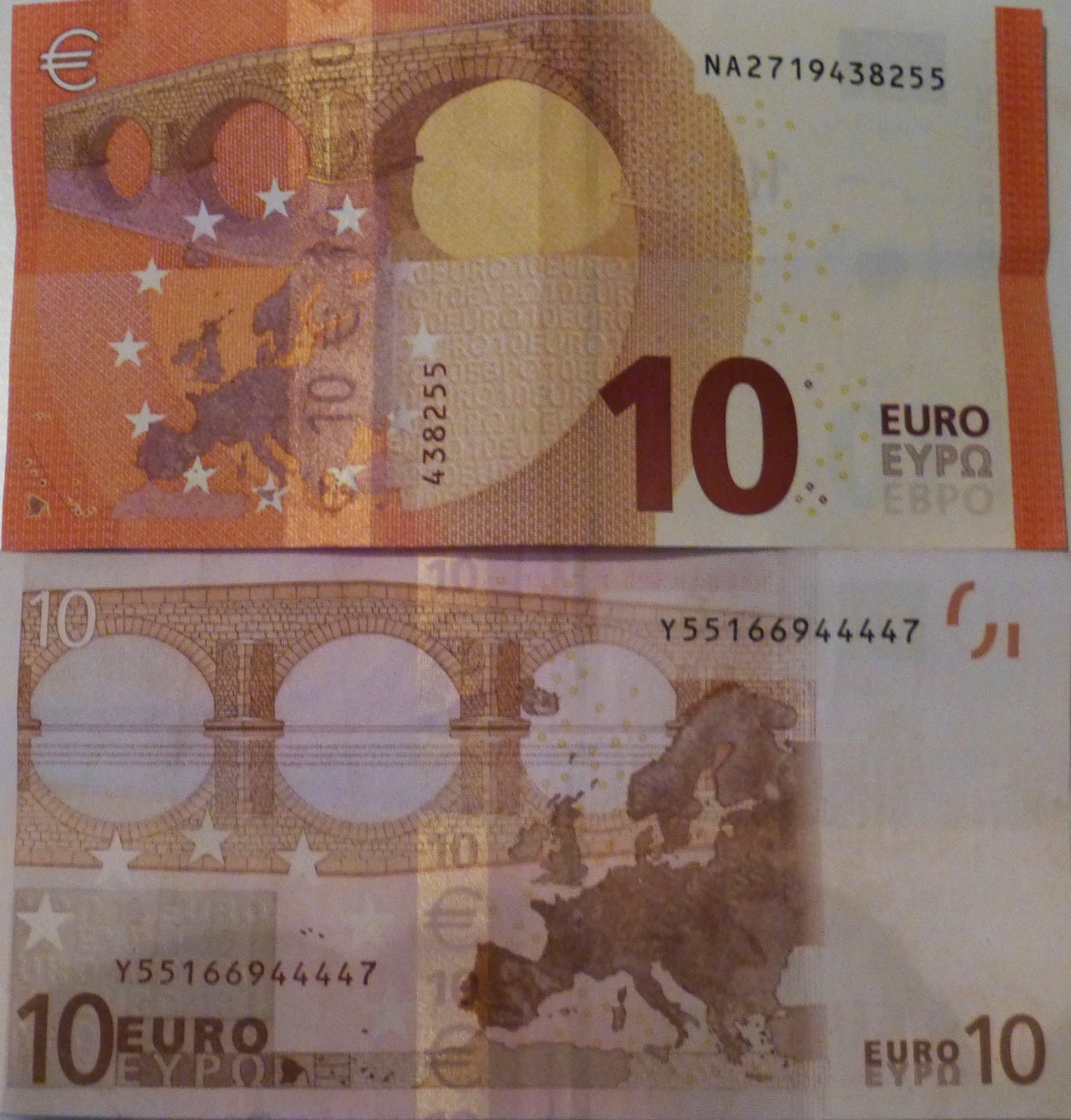
New €10 Banknote

Circulation of the new €10 banknote began on 23 September.  The new €5 banknote launched last year so I assume that the new €20 banknote will be released in 2015.

Like the fiver, the new tenner also has some new security features built in to the banknote.

Front side


Here's a comparison of the new and old banknotes.

The new version is on top and the old version is on the bottom.

Back side


The old banknotes used to have "EURO" and "ΕΥΡΩ" on them since all of the Eurozone countries used either the Latin or Greek script.  Although Bulgaria has yet to adopt the Euro it will eventually have to since the country has joined the European Union.  So now all of the new banknotes include the Cyrillic "EBPO".

Here's a commercial I found on YouTube about the new banknotes.

  ©European Central Bank

Tuesday, October 7, 2014

I survived!

I survived!  Some people had no idea how I was going to survive my family's first visit to Europe.  And for five weeks no less.  Well it really wasn't that difficult.  But it was a good thing, after a few weeks, to send them off to Budapest alone so that everyone could take a breather.

I left my family in Vienna and I came back to Brno today.  Tomorrow they are headed to Munich for a week and then they return to Prague to catch their flight back to the USA.  My flat now seems really empty and quiet now.

It was a great to have my family come visit.  I still can't believe that the last five weeks went by so quickly.  They finally got to see where I live and to meet some of my friends whom they've heard so much about over the years.  My dad even said that he now understands why I live in Europe.  Now to get them back for another visit in a couple of years.  Next time we may hit northern Poland, Scandinavia and Ireland.  But before that I'll need to go visit the USA first, perhaps in 2016 or 2017.

Monday, October 6, 2014

Vienna Trip

The Czech portion of my family's Eurotrip ended and we are now in Austria.  We've been busy exploring all of the Vienna highlights including the Rathaus, opera, Stephansdom and Peterskirche.

Rathaus (town hall)

Dad was feeling tired so he stayed in today.  My aunt and uncle went off to do their own thing so mom and I got to spend the whole day together exploring the city on our own.  What a great day!

Mother-Son sightseeing

Prior to this trip mom had never been on a subway before but after only a couple of days she is now a metro expert.

Schönbrunn Palace
We went to Schönbrunn and toured the palace.  The tour group ahead of ours was a private tour for the president of Switzerland.  You can't take photos inside the palace but here's a Rick Steves video I found out on YouTube that gives some highlights.

 
© Rick Steves

We ended the day with a visit to Aïda, near Stephansdom, which is my favorite Vienna coffee & pastry shop.  It is Europe's largest privately owned coffee shop and they produce about three tons of cakes per day.  They even roast their own coffee beans.  It was a great way to end a fabulous day with mom.

Sunday, October 5, 2014

Valtice, Czech Republic

Valtice is small Moravian town near the Austrian border.  It is part of the Lednice-Valtice Cultural Landscape which is a UNESCO World Heritage Site.

Prior to WWI, Valtice was known as Feldsberg and was part of the Austro-Hungarian Empire.  Feldsberg was upgraded from village to town around 1383.  After WWI, Feldsberg became Valtice and became part of Czechoslovakia.  Today the town has a population around 3,600 people. 

The 14th century chateau was built as the main residence of the Dukes of Liechtenstein.

Construction on the Parish Church of the Assumption began in 1631.  It took almost 40 years to complete.  In 1992, two new bells were presented by the bishop to celebrate Valtice's 800th anniversary.

Valtice town hall


The earliest record of the Valtice town hall dates back to 1393.


The town's plague column commemorates the victims of the plague which wiped out about a quarter of the population.


We went to Valtice yesterday for the wine fest.  I really wanted my family to see a traditional Czech vinobraní.  I don't know if it was because of the weather or because we were there too early, or if Valtice's wine festival is always small but I was kind of disappointed.

There were only a few people in traditional costumes and there wasn't too much folk music.  The emphasis here really seemed to be just with the food vendors.  This has to have been one of the smallest, low-key festivals that I've been to in the past +5 years.  I think that it was fine for my parents because they had nothing to compare it to but I wish they would have seen something more.

Thursday, October 2, 2014

Kazimierz & Podgórze

After our filling food tour we took a tour of Kraków's Kazimierz and Podgórze districts.  Kazimierz was Kraków's center of Jewish life for more than 500 years.  It was founded by Polish King Kazimierz the Great in 1335 and is the oldest Jewish quarter in Poland.  But it was not an exclusively Jewish as there are some Catholic churches in the area.


Skałka is St. Stanisław's Church.  In 1079, Bishop Stanisław excommunicated King Bolesław so the king accused the bishop of treason and had him beheaded and dismembered in the church.  St. Stanisław was canonized in 1253 becoming the first native Polish saint.  He is the patron saint of both Poland and Kraków.

A few well known writers and artists are buried here including Czesław Miłosz who died in 2004.  Czesław Miłosz was a Polish poet and diplomat who defected in 1951 and became a U.S. citizen in 1970.  In 1980 he won the Nobel Prize in Literature.

The Temple Synagogue is the newest synagogue and dates back to 1862.  During German occupation in WWII the synagogue was used as a warehouse and as stables.
Inside Temple Synagogue

There is quite a bit to see in the neighborhood and today there are lots of  cafes and art galleries. 

During the Nazi occupation, Jews were moved out of Kazimierz and across the river to the ghetto in Podgórze.

Very little remains of the Kraków ghetto as most of it was liquidated in 1943.  There is a portion of one of the walls with a plaque remaining.

Schindler Factory Museum

The Jewish ghetto was located near Oskar Schindler's enamel factory which operated from 1939 to 1944.  Today it is a museum dedicated to the 1,200 Jews Schindler saved during the Holocaust.   

Some of those Schindler saved
Israel declared him Righteous Among the Nations and a tree is planted in his honor at Yad Vashem.  Schindler died in 1974 and he is buried in a Catholic cemetery in Jerusalem.

St. Joseph's Church
What is now Plac Bohaterów Getta, Ghetto Heroes Square, is home to 70 over sized bronze chairs as a memorial to the Kraków Jews who were sent off to concentration camps.  The chairs represent the possessions discarded by deportees and there is one chair for every 1,000 people who were shipped out from this very place.

The Neo-Gothic St. Joseph's Church was built from 1905 to 1909.

Wednesday, October 1, 2014

Kraków Food Tour, Poland

Poland is one of my favorite countries to visit.  Part of it has to do with the food.  It is so dang good which my family has found out.  Many cities offer free walking tours but in Kraków there is a free Polish food tour offered by Cracow Free Tours.

Our guide Kasia took us to four different spots in the city and we tried something different in each one.  Along the way she pointed out various points of interest.  The tour itself is free (you just tip the guide at the end), and you pay a reduced price at each place.  The total for the food was only about 20 zł ($5.60 / €4,60) per person.  Quite the deal!

Pickled herring with sour cream & onions
Our first stop was at Ambasada Śledzia to try herrig.  Śledź is served two different ways in Poland.  Either with oil and garlic or with sour cream and pickled onions.  We had the sour cream and onion version with bread.

Żurek
Our second stop was at Kuchnia U Doroty for soup.  Żurek is a sour ryemeal soup that contains cabbage, potato, sausage and boiled egg.  This was really good and we'll have to find a recipe so that dad can ferment rye flour for the soup base back home in Arizona

Ruskie pierogi
Our third stop on the culinary tour was at Pierogi Mr Vincent.  Pierogi are Polish dumplings made from thinly rolled-out dough and there are many different kinds.  Some have meat, some have cabbage and mushrooms or spinach and cheese, some have strawberries or some other seasonal fruit, and some have a sweet cottage cheese filing.  The most popular are Ruskie pierogi which are filled with potato and cheese and topped with fried onions.

Gołąbki with mushroom sauce
Our fourth and final stop was at Warsztat for a cabbage roll.  Gołąbki is minced pork with rice, onion and mushrooms, all wrapped up in cabbage leaves.  It normally comes with either a mushroom sauce or a tomato sauce.

Everything was really good.  What's neat about the tour is that you get a very filling lunch, get to sample several Polish delicacies, and you get to see a bit of the city while you burn a few calories walking around.  The only thing that could have made it any better is if we stopped someplace for some Żubrówka z sokiem jabłkowym (Żubrówka with apple juice).  But that's easy enough to take care of on our own.  

Tuesday, September 30, 2014

Seeing Auschwitz & the Salt Mine Again, Poland

I went to Auschwitz and the Wieliczka Salt Mine when I went to Krakow in 2010.  While I knew that my family wanted to visit both I wasn't really looking forward to it.  Don't get me wrong, they are both must-do's when you come to Poland.  It's just that I had already seen them.  Especially Auschwitz.

After you've been there you can't really say that you've had a good day, in the traditional sense.  It is such a powerful experience that it leaves you kind of spent afterwards.

Well I was wrong.  Both places have made changes since the last time I was there that I didn't feel like I was seeing everything for a second time.

Auschwitz was different because the last time I was there was in the middle of winter and the snow gave it a different vibe.  This time the tour was conducted with headsets so it was easier to catch everything that the guide had to say.  But the biggest difference was that we saw so much more of Auschwitz II-Birkenau.  Last time we only spent, maybe, 30 minutes at Birkenau.  This time we were there for almost two hours.  Perhaps they shortened the tour last time due to the cold.

The salt mine too now used headsets for the tour.  There have been some enhancements and there was actually much more to see this time than there was before.

Sunday, September 28, 2014

Kraków Visit

We made it to Kraków, Poland today.  We took the Student Agency bus to Ostrava and from there caught a different bus to Kraków.  All told it took about seven hours to get here.  We rented a big apartment off of the main square and since we have plenty of room, Claudia and Tünde came along too.

Currently there is a Jarhmark going on to celebrate Saint Michal so my parents get to see another market with all of the arts & crafts and food.

The plan over the next few days is to take in the city and also visit Auschwitz and the Wieliczka Salt Mine.  And of course, we have to visit a milk bar at some point.

Tünde likes the horses and carriages around the main square.  At some point I'm sure she'll get to go for a ride.

Thursday, September 25, 2014

A1 Language Exam

July 1st was my five year anniversary in Czechland and as of then I've been eligible to apply for permanent residency.  In order to apply I am required to pass a basic Czech language exam.  Unfortunately, I've been so busy with work, and with my family's visit, that I haven't had the time to take the exam.  On Monday, everyone left for Budapest for five days which gave me the opportunity to catch up with things at work and to take my language exam.

Voucher for free exam
Last week, I had to go to the foreign ministry to pick up a voucher for the exam.  All applicants are entitled to take the exam one time for free.  If you don't pass the exam the first time then you have to pay 1,500 Kč (~$75) for each retry. 

For permanent residency you only have to pass the A1 level.  This means that a person can handle simple conversation about common everyday situations concerning oneself, one's place of residence, property, relatives and acquaintances when:
  • visiting public institutions, post offices, shopping, ordering services or food;
  • dealing with officials, health care providers;
  • handling accommodation and public transportation 
A1 means that you have basic survival Czech.

The first part of the exam covers reading, listening and writing.  The reading portion takes 20 minutes and you have to answer multiple choice questions.  The listening comprehension part last about 35 minutes.  You hear quick conversations and have to answer multiple choice questions.  This was the most difficult part for me.  Then comes the written portion which lasts for 15 minutes.  You are given a theme to write about.

If you successfully pass these three parts then you can take the verbal portion.  I had to sit one-to-one with the examiner for about 5 minutes and hold a conversation about how long I had been in the country, where I was from, what I liked about the Czech Republic, etc. 

My official A1 certificate
I passed!!  My Czech is better than A1 but I was still nervous about the exam because I had to pass it.  If I apply for Czech citizenship in five years then I will have to take the B1 exam which will be much more difficult. 

Now I just need to get notarized copies of my paperwork and submit everything to the foreign ministry.  Hopefully I can find the time and get an appointment in November.

Update:  I applied in December.