Monday, March 15, 2021

Czech Sign Language

Český znakový jazyk (ČZJ) is Czech Sign Language.  Czechland has its own sign language.  The Institute for the Deaf and Dumb in Prague opened in 1786.  It was the 5th such institution in Europe.

Every sign language has its own finger alphabet.  The Czech version is two-handed.  They have a sign for the accent marks.

There are around 10 000 people in the country that can use it.  Czech and Slovak are pretty much mutually understandable when spoken.  This does not carry over to sign language.  I'm told that Czech Sign Language isn't that close to Slovak Sign Language.  

Some Czech Sign Language Verbs

Sunday, March 14, 2021

Hantec

Hantec is the local Brno dialect.  The language was most spoken amongst the lower classes in the 19th and early 20th centuries.  Very few, mostly older people, can actually speak proper Hantec.  Many Hantec words and phrases have worked their way speech of the locals. 

It's a mix of Czech, the local Moravian dialect, German, and Yiddish.  It's been described as an "unintelligible funny German-like and alien gibberish." I find it charming.

In the rest of the country a tram is tramvaj.  Here it is a šalina whcih comes from the German "elektrische Linie".  When I'm in Prague and say šalina instead of tramvaj they instantly know that I'm from Brno.  

The Brno city centre is called Štatl which comes from the Yiddish word shtetl. The  Brno Dam is called Prýgl, Česká street is called Čáró and the train station is Roló.

Here are a few more...

Augle is eyes and čočky are eyeglasses.  Ď is thanks.  Hokna is work.  Ká and love both mean money and kéma is friend.  Potatoes can be called krumple or erteple.  Gómat means to think. Čórka is a theft, šaškec is a madhouse and koc is a girl.  Metr doesn't mean metre, but month, so za dva metry actually means "in two months"; not in two metres.

Here's a link to an online Hantec dictionary.

Friday, March 12, 2021

Czech Dialects

There's a difference between formal, written Czech and colloquial spoken Czech.  Standard Czech is what you'll hear across the country on the nightly news.  However, everyday Czech is a bit different.  

Just as there are three distinct regions in Czechland there are three primary Czech dialects to be found.  There's a dialect spoken in Silesia, near the Polish border, that a mishmash of Czech and Polish.  The dialect is actually closer to Polish than it is to Czech.  That doesn't mean that people there can't, or don't, speak standard Czech but the accent can be tough to understand if you're not used to it.  It's been referred to as "unintelligible funny Polish-like gibberish."

The most widely used spoken Czech is the variety found in Bohemia.  There are some grammatical differences from standard Czech.  There are also some pronunciation differences where Bohemians have more open vowel sounds than Moravians, especially in Prague.

In "Bohemian" -ý becomes -ej and -é becomes -ý.  The word dobrý (good) becomes dobrej  and dobré becomes dobrý.  Given the seven Czech cases there are more words to keep up with.

The declension of můj (my) gets changed from: mého to mýho, mému to mýmu, mé to mý, mém to mým, mých to mejch, mým to mejm, and mými to mejma.

The declension of dobrý changes word forms from: dobrý to dobrej, dobré to dobrý, dobrého to dobrýho, dobrému to dobrýmu, dobrém to dobrým, dobrých to dobrejch, dobrým to dobrejm, dobří to dobrý, and dobrými to dobrejma.

In Bohemia they don't really follow the rules for the 7th (Instrumental) case when it comes to plural words.  They just use -ama or -ma for everything.  So hranokly (French fries) becomes hranolkama, brambory (potatoes) becomes bramborama, and auty (cars) becomes autama.

In Bohemia, then tend to put a "v" sound before words that start with "o".  Okno (window) becomes vokno, oko (eye) becomes voko, omáčka (sauce) becomes vomáčka, ostrý (sharp) becomes vostrej, ospalý (sleepy) becomes vospalej...

Moravians don't do any of this.  Another thing that distinguishes people from Prague is that when they speak it is kind of singsongy.


I'm told that Moravians speak better proper Czech than Bohemians do.  However, Moravia has more local dialects.  And Moravians for sure don't sing when they speak.  

The biggest pronunciation differences in the Moravian dialect are:

-í/ý becomes é.  The word for "mill" in Czech is mlýn but becomes mlén.
-y becomes e.  The plural world for "fish" is ryby but it becomes rebe.
-the diphthong ou becomes ú.  The world for "flour" is mouka but it becomes múka.
In Czech, "I am" is já jsem but in Morava you'll hear já su.  "I want" is chci but you'll often hear people say chcu.  

There's some different vocabulary used in Moravia.  


In Brno, we have our own dialect called Hantec.  It's a mixture of standard Czech, the Moravian dialect, German and Yiddish.  Hantec is spoken mostly by older people but many Hantec words are used by everyone in everyday conversation.  Šalina is the most well known word.  It means "tram" but the rest of the country uses the world tramvaj.  When I'm in Prague and say "šalina" people instantly know that I'm from Brno.

Monday, March 1, 2021

No Plane in a Year

It's now been a year since I've been on a plane.  A full year.  Last year I went to the Åland Islands and managed to get in a quick visit with Eiko in Helsinki before my flight home.  That airBaltic flight from Helsinki to Vienna was the last time I was on an airplane.

A full year for me without a flight.  That would have seemed impossible last year.  COVID-19 changed the world and who knows how long it will take before things get back to normal?  Or at least as close as possible to what normal used to look like.

My last flight

Last year the goal was 20 countries in 2020.  That didn't happen.  I did manage to get up to Berlin in July for a week in between lockdowns.  I am ready for a trip someplace.  Any place.  However, with the new lockdown it's anyone's guess when that will happen.  All I can do now is continue to stay as safe as possible and wait it out.  

Speaking of waiting, I've still got my citizenship test scheduled for 10.4.  At least for now but I have a feeling that it will get cancelled again.

Sunday, February 28, 2021

TV Licence Fee

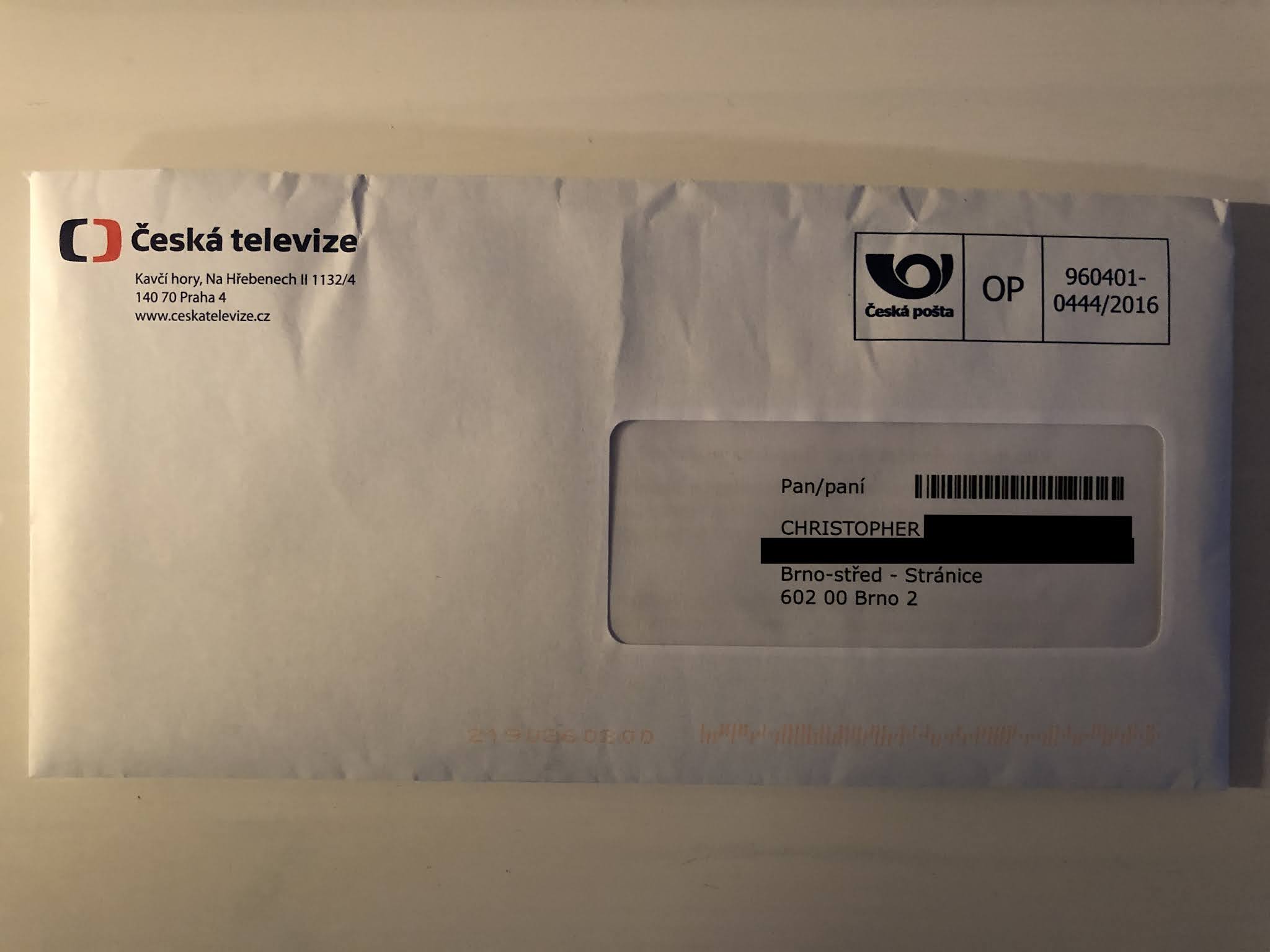
Last week I received a letter from Czech Television letting me know that I need to pay a TV licence fee.  I do own a television but I use it to watch Netflix, YouTube or AppleTV.  I don't watch Czech TV, I don't have cable or satellite service so what gives?  

Apparently every household that owns a television, whether you use it or not, is required to pay 135 Kč ($6 or €5) a month.  You have the option of paying monthly, quarterly or annually.

The money goes toward funding Czech Television (Česká televize) and Czech Radio (Český rozhlas).  Neither receives any government funding so the money received from licensing helps keep public broadcasting independent from political influence.

Every household is required to pay regardless of how many televisions or radios they own.  Business and the self-employed have to pay a licence fee for each television and radio owned.

Apparently they got my info from my electric provider.  A friend of mine in Prague received the same notification last week so I guess there's a push right now to collect.  TV licensing fees aren't a thing in the USA but they are normal in Europe with each country doing its own thing.  In Germany for example the monthly fee is €17,50 while there's no fee in Spain.

The letter I received did provide for the option of declaring that I don't own a television.  I really don't want to get in trouble for not paying my TV fee when I'm trying to apply for citizenship.  I just went online, paid the yearly fee and now I'm covered.

Saturday, February 27, 2021

Increased Lockdown

The COVID-19 situation in Czechland continues to get worse and now the South African variant has shown up here.  From 26.2. until 11.4., all Czech citizens and residents are prohibited from travelling to Botswana, Brazil, Eswanti, Kenya, Lesotho, Malawi, Mozambique, South Africa, Tanzania, Zambia or Zimbabwe.

From 1 March, all schools including kindergartens will be closed.  So far only first and second grade classes have been open but now they will all close again.  There's an exception for child groups at healthcare facilities for the children of first responders.

The government will also restrict the free movement of people for three weeks.  People must remain in their district.  If you do need to travel outside of your district for work, to go to a doctor or public authority or to an airport, then you need to have written confirmation from your employer or a sworn affidavit.

Brno-City and Brno-Outskirts are considered a single district for the restriction of movement.  Some 26.000 police officers will be deployed to enforce the restriction.   About 5.000 soldiers will be used to reinforce the police.  

It's a good thing that I didn't choose to take my exams in March because with the new restrictions I won't be allowed to travel to Prague.

Thursday, February 25, 2021

New Mask Requirement

From today there's a new requirement to wear respirators or N95 masks instead of home-made roušky.  Respirators have to be worn in all shops, on public transit and at stops, at airports, in medical facilities, in cars if passengers aren't members of the same household, and in all buildings or outside when you are less than two metres (6 feet) apart.

There are a few exceptions but the big one is for children under 15.  I don't quite get this.  I can see an exception for small children.  But all kids under 15?

Monday, February 22, 2021

Mail Delays

There are still postal delays due to COVID-19.  Today I received a Christmas card from the Wellington Whānau in New Zealand.  Better late than never.  At least it made it.  Much love back to everyone back in Kiwiland.

Sunday, February 21, 2021

Abortion

Abortion can be a divisive topic for some.  Some people argue that an embryo or foetus is human being so abortion equals murder.  Others view abortion as a cornerstone of a woman's right to make decisions about her own body.  Religion deepens the divide between the two sides.  Globally there are about 56 million abortions performed each year.  Roughly 45% of these are not performed safely which to me makes it a matter of public health.  

Abortion was legalised but with restrictions in Czechoslovakia in 1957.  In 1986 the restrictions were lifted.  The increased availability of contraception and sex education have contributed to decrease in the number of abortions performed in the country.

In Czechland it is legal to have a an abortion up to 12 weeks of pregnancy for any reason.  Abortions are allowed up to 24 weeks for some medical reasons and at any time due to a malformed foetus.  Abortions for non-medical reasons are not covered by the public health system.  The average price is around 4500 Kč ($205 or €170).  

EU citizens can legally come to the Czech Republic for an abortion.  This is good news for women in Poland.  Only around 1000 legal abortions were performed in Poland each year because the country already had some of the most restrictive abortion laws in Europe.  The Polish government now only allows abortion in cases of rape, incest, or when the pregnancy threatens the mother's life.  Abortions due to foetal abnormalities are no longer allowed.

This has led to mass protests against the Polish government.  A red lighting bolt has become the main symbol at Poland's pro-choice demonstrations.  It's estimated that 100.000 women each year travel to another country, usually Germany, Czech Republic, or Slovakia, for a safe and legal abortion.  The scary number is how many women have unsafe "back alley" procedures because it is illegal in Poland?  

Saturday, February 20, 2021

Czech Gun Rights

Czech law permits gun ownership to those who can pass a gun proficiency test, a medical exam, and who have a clean criminal record.  The majority of gun owners here report having a weapon for self-defence and not for just sport or hunting.  This is one of the safest countries so I don't quite understand the self-defence reason but to each their own.

There are five different types of gun licenses here.

Type A = Firearm collection
Type B = Sport shooting
Type C = Hunting
Type D = Exercise of a profession
Type E = Self-defence 

A application for a gun license is made with the police.  A application fee is 700 Kč ($30) and the license is issued in 30 days.  It is good for 10 years before needing to be renewed.  

For sport and hunting, types B or C, the applicant must be at least 18 years old.  There are special exceptions if the applicant is a member of a sporting club or if hunting is taught as part of a school curriculum then 15 or 16 year olds can get a license.  The minimum age for A, D, or E license types is 21.

Anyone who excessively drinks alcohol, uses illegal drugs, or those found guilty of misdemeanours related to firearms, DUI, or public order in the previous 3 years don't qualify for a gun license.

Ex-convicts who served more than 12 years in prison are not allowed a gun permit.  Convictions for public endangerment, murder, treason, or participation in organised crime are not allowed a permit.

Those who serve less than 2 years in jail are eligible to apply after a 5 years.
Those who serve sentences for 2 to 5 years can apply after 10 years.
Those who serve sentences for 5 to 12 years can apply after 20 years.
For those who server sentences more than 12 years are ineligible from ever getting a gun permit.

There's no limit on the number of guns a person can own.  There are safe storage requirements of owning more than 2 weapons or having more than 500 rounds of ammunition.  There are additional requirements if a person has more than 10 guns and further requirements for having more than 20 guns.

Possessing a firearm without a license carries a penalty of up to 2 years in jail.  In some cases this goes up to 8 years.  Carrying a gun while intoxicated is illegal.  There are heavy fines and forfeiture of one's gun license.  

Across most of the EU, the concealed carry of firearms is not allowed.  Here though it is allowed provided the owner has a concealed carry permit.  I've heard that around 80% of gun owners here also have a concealed carry permit.  It is against Czech law to carry any weapon during a public demonstration.  It is also illegal to carry a weapon with a silencer installed.

During the German Nazi occupation it was illegal to posses firearms.  During communism only those seen as loyal to Communist regime were allowed to possess guns.  Given these historical restrictions the right to posses firearms is viewed as an essential liberty.  But it's not like everyone here owns a gun.  There's something like 12 or 13 guns for every 100 people.  In contrast to the USA where there are about 120 guns for every 100 people.  The USA can't even pass common sense gun legislation.  I feel much safer here in Czechland than I do in the USA.

From 1 January to 31 July 2021, there is an amnesty running where any illegally-held weapons can be turned over to the Czech police, no questions asked.  Or if you have a valid gun license and proof that the weapons wasn't stolen or used to commit a crime then you can legally register the gun.  

The last time this was done was five years ago and most of the weapons turned in dated back to WWII and the Soviet occupation.  The Czech police released a video on YouTube and with typical Czech humour it shows a guy turning over a Soviet tank.  

©Policie ČR