Sunday, February 11, 2018

Brno Street Name History

When Brno was part of the Austro-Hungarian Empire, all of the street names were written in German.  After 1918, and an independent Czechoslovakia, the street names were written in Czech, although many still had unofficial German versions.  During occupation, the streets were again written in German but now had unofficial Czech versions.  Since the end of WWII, in 1945, all of the signs have been in Czech.

In the 1990s the street names changed again.  Like most countries after the fall of communism, many places in Czechland starting removing communist era names and giving them new names.  Here are some of the biggest name changes that I've come across in some of the various Brno neighbourhoods.

Brno Centre
In 1915, the main square in the centre was called Kaiser-Franz-Josef-Platz.  In 1918, it became náměstí Svobody (Freedom Square).  On 17.3.1939, it was named Adolf-Hitler-Platz during his one day visit to Brno.  The next day it became Freiheitsplatz.  In 1942, it was renamed náměstí Viktoria and in 1945 it once again became náměstí Svobody.

In 1915, the Krautmarkt became Kaiser-Wilhelm-Platz.  In 1918, it became Zelný trh (the Czech version of Krautmarkt).  In 1952, it became náměstí 25. února (February 25th Square) to commemorate the communists taking power in 1948.  In 1990, the square's name was changed back to Zelný trh.

In 1990, náměstí Rudé armády (Red Army Square) became Moravské náměstí (Moravian Square).  The Red Army soldier is still there.

Nová became Reinhard-Heydrich-Straße (třída Reinhardt Heydricha) in 1942, in honour of Reinhard Heydrich (1904-1942), the Nazi Reich Protector in Bohemia and Moravia who was assassinated.  In 1945, it became Nová again.  Then in 1946 it became Lidická, in honour of the village of Lidice.  The village in Bohemia was destroyed on 10 June 1942 in retaliation for Heydrich's assassination.

Alois Rašín
Kostelní became ulice 9. května (May 9th Street) in commemoration of the end of WWII.  Remember that the Soviet Union and other communist countries celebrated on 9 May.  After the Velvet Revolution, the day was changed here to 8 May to match the correct time zone of when Nazi Germany actually surrendered.  In 1991, the street became Rašínova to honour Alois Rašín (1867-1923), a politician and national economist who was assassinated.

T.G. Masaryk
Masarykova is the main Brno centre street that runs from the train station to námeěstí Svobody.  In 1939, it was renamed Hermann-Göring-Straße (třída Hermanna Göringa), after Hermann Göring (1893-1946), the German Nazi Air Force Marshal and Minister of Defence.  On 10 may 1945, it became Masarykova again after Tomáš Garrigue Masaryk (1850-1937), the father of Czechoslovakia.  In 1955, the communists changed the name to třída Vítězství (Victory Road) in honour of the Red Army's victory over Nazi occupation.

In 1968, even after the Soviet and Warsaw Pact forces invaded, the street once again became Masarykova.  Surprise...in 1970, it was renamed třída Vítězství again.  In 1989, after the Velvet Revolution, the street became Masarykova and the name has stood for almost 30 years.

In 1946, Koliště was renamed Stalinovy sady (Stalin Gardens) after Josef Stalin.  In 1953, it became sady Osvobození (Liberation Gardens) in honour of Brno's liberation from Nazi occupation in WWII.  In 1990, it got it's old name back and the street is again called Koliště.

Kobližná was renamed Gagarinova in 1961 in honour of Yuri Gagarin (1934-1968), the Soviet cosmonaut, who in 1961, became the first person to fly in a rocket.  In 1990, Kobližná got its old street name back.

Not everything communist was done away with.  In 1946, náměstí Richarda Wagnera (Richard Wagner Square) was renamed Malinovského náměstí (Malinovsky Square) after Soviet Marshal Rodion Malinovsky (1898-1967), the army commander who liberated Brno from Nazi occupation in 1945.  This is the square where the Mahen Theatre is and there's a Malinovsky memorial nearby.

Veveří
From 1915 to 1918, Veveří used to be called Hindenburgstraße (Hindenburgova), after Paul von Hindenburg (1847-1934), the German Field Marshal and President.

Václav Kounic
In 1946, Giskrova was remanded Leninova (Lenin Street).  In 1990, the street was renamed Kounicova, after Count Václav Kounic (1848-1913), a Czech nobleman, lawyer and politician who supported Czech secondary school in Brno and who a patron of the Brno university colleges for Czech students.

Obilní trh was renamed Stalingradské náměstí (Stalingrad Square) after the Soviet city in 1946.  In 1963, it became náměstí Sovětských hrdinů (Soviet Heros Square) until it once again became Obilní trh in 1990.

Milan Ratislav Štefánik
In 1946, Pražská (Prague Street) became Eisenhowerova, after Dwight Eisenhower (1890-1969), the general of the western allied forces in WWII.  In 1948, the street was renamed Dimitrovova, after George Dimitrov (1882-1949), the Bulgarian communist party official and statesman.  In 1990, it became Štefánikova, named after Milan Ratislav Štefánik (1880-1919), the Czechoslovak astrophysicist and general who was the country's first Minister of Defence.  He helped Masaryk create an independent Czechoslovak Republic.

Královo Pole
Kosmas
In 1958, Manželů Rosenbergových (The Rosenbergs Street) was built in honour of Ethel (1919-1953) and Julius (1921-1953) Rosenberg who were executed in the USA after being found guilty of disclosing atomic secrets to the Soviet Union.  In 1991, the street was renamed Kosmova after Kosmas (1045-1125), the founder of Czech historiography.

Jan Skácel
In 1946, Moskevská (Moscow Street) was built.  In 1990, it became Skácelova, in honour of Jan Skácel (1922-1989), a Brno poet, writer, translator and publicist.

Židenice
In 1961, náměstí Komsomolců was built.  Komsomols were members of the communist youth league in the Soviet Union.  In 1991, it became Juliánovské náměstí.

Černá Pole
Milada Horáková
In 1946, Francouzská (France Street), became Churchillova in honour of Winston Churchill (1874-1965).  In 1948, it became třída Jana Masaryka (Jan Masaryk Road), named after Czech diplomat and politician Jan Masaryk (1886-1948), the son of President Masaryk.  Then in 1952, the name was changed to třída Říjnové revoluce (October Revolution Road) to commemorate the 1917 October Revolution in Russia.  In 1990, it became Milady Horáková, in honour of Milada Horáková (1901-1950), a lawyer and sociologist, who was executed by the communist regime following a political show trial.

I'm sure that there are many others.  The name changes over the years is like a living history class.  I never would have known that I once lived on the corner of Lenin Street.

I bet all medium to large cities in the USA have a Martin Luther King Street.  Most Czech towns all have a Masarykova, Dobrovského, Dvořákova, Jungmannova, Komenského, Palackého, and Sokolská.

Tuesday, February 6, 2018

Mikolas Josef

This year, the Czechs have picked 22 year old Mikolas Josef as their Eurovision entry for May.  More than 400 entires were submitted and the top six entires.  These six were put before a popular vote and a professional jury and Mikolas won 53% of the vote.


Mikolas Josef began as a fashion model for Diesel and Prada at 17.  After modelling he turned to singing and songwriting.  I've heard people refer to him as the Czech Justin Bieber.

His song "Lie To Me" is a catchy tune about not getter swallowed up by negativity during tough times.  Here's the video for his song.  Good luck to him!

©Eurovision

Update:  He placed 3rd in the first semi-final and finished in 6th place in the grand final.  That's the highest that Czechland has ever placed.

Saturday, February 3, 2018

Česká pošta

Česká pošta, Czech Post, became a state-owned enterprise on 1 January 1993 when Czech Republic became an independent country.  There are over 3800 post offices around the country.

In Czechia, mail is delivered Monday through Friday.  Mail is only delivered; outgoing mail is not picked up.  If you want to post a letter then you need to go put it in a mailbox or go to the post office.

Most post offices here are open from 8 AM to 6 PM, Monday to Friday.  On Saturdays, many are open from 8 AM to Noon.  Most are closed on Sundays and definitely closed on public holidays.

We're lucky here in Brno because the main post office is open from 6 AM to 12 AM, Monday to Sunday.  I've actually mailed packages before at the post office at 9 PM on a Sunday.  That would never happen in the USA.

Plus the Brno post office has a Paternoster lift.  Very cool!

On 1 February, new pricing went in to effect.  Ordinary letters weighing up to 50 grams will now cost 19 Kč.  Registered letters up to 50 grams will now cost 44 Kč.

Domestic letters weighing up to 1 Kg will cost 33 Kč.  Registered letters up to 1 Kg will now cost 66 Kč.  Insured letters will now cost 49 Kč.

The cost for mailing packages will change too.  There will be fewer weight categories.  The number of weight categories between 2 Kg and 50 Kg will now has seven instead of 23 price points.  In a few cases, some will be cheaper.

I'm pretty sure that the new cost for sending an international post card will be 35 Kč ($1,69).

Monday, January 29, 2018

IBM Photo Shoot

Back in the end of November I participated in my first photo shoot.

As part of a global marketing campaign, professional photographer Mike Webb travelled to shoot IBMers all over the world.

The photo shoot was surprisingly fun.
I finally received some of the untouched photos.  I doubt that any of my photos will be used but who knows?

Friday, January 26, 2018

Seriously?!?!

So here's the deal.  On 12-13 January, Czechs went to the polls to elect a president.  In order to run for president a candidate needs either 50,000 signatures from the public, 10 signatures from senators or 20 MP signatures from the Chamber of Deputies, plus file applications at least 66 days prior to the election.  Of the nine qualified candidates, none won enough votes so the top two finishers face each other in a run off election this week.

The two candidates are the incumbent President, Miloš Zeman, and Jiří Drahoš, the former President of the Czech Academy of Sciences.

I don't get a vote but I'd definitely prefer Drahoš.  Anyway, Zeman supporters left this flyer in my mailbox today.
 
Stop Immigration and Drahoš supporters.  This country is ours.
Vote Zeman!

Seriously!?!?!  Czechland has population of 10,597,473 people with only 4,95% foreigners.  43,6% of all foreigners come from Slovakia and Ukraine.  The country has only admitted 14 refugees.  So what exactly is the immigration problem?

Update:  Well Zeman won re-election.  President Zeman won with 51,36% of the vote and will remain president until 2023.  Voter turnout was 66% and the entire election came down to a difference of 160,000 votes.

Drahoš took 48.63% of the country.  But in Brno he won 57,58%.

Wednesday, January 24, 2018

Czechoslovakia

My 1,400th blog post.  Lucky for me it still doesn't look like I'll run out of material to write about anytime soon.


Czechoslovakia would have been 100 years old this year.  The country dissolved in to the Czech Republic and Slovak Republic in 1993.  Of course, it's still funny that so many people think that Czechoslovakia still exists.
As the Austro-Hungarian Empire fell apart at the end of WWI, Tomáš Garrigue Masaryk, the first president, founded the Republic of Czechoslovakia (RČS) on 28 October 1918.  The new country of 13,5 million people was made of up the areas of Bohemia, Moravia, Czech Silesia, Slovakia, and Carpathian Ruthenia, which contained some of the most industrialised regions of the former empire.

The First Republic lasted from 1918 to 1938.  In 1920, the country's official name was changed to the Czechoslovak Republic (ČSR).  Československo was one of the world's ten most industrialised states, the fourth in Europe, and had a thriving democracy.  After 1933, it was the only functioning democracy in Central and Eastern Europe.

Following the Munich Agreement and the Nazi annexation of the Sudetenland.  The country also lost southern parts of Slovakia and Subcarpathian Ruthenia to Hungary and part of Silesia to Poland.  This pretty much ended the First Republic and the new Second Republic only lasted for 169 days until Germany occupied the rest of the country in 1939.  From 1939 to 1945, what was left of Czechoslovakia was split into the Protectorate of Bohemia and Moravia, and the Slovak Republic which was set up as a Nazi puppet state.  While there was no more Czechoslovakia, a government-in-exile, the Third Republic, continued to operate from the UK.

After WWII, Czechoslovakia regained its pre-war borders except for Subcarpathian Ruthenia which was annexed by the Soviet Union.  President Beneš stripped citizenship from ethnic Germans and Hungarians who took German or Hungarian citizenship during the occupations.  The new government then confiscated the property of about 2 million ethnic Germans and expelled people from the country.  This was the background for the Brno Death March.

The country fell into the Soviet sphere of influence and became a satellite state.  From 1946 to 1948, Czechoslovakia had a coalition government until 1948 when the Communist Party of Czechoslovakia (KSČ) seized power in a coup and eventually established the Czechoslovak Socialist Republic (ČSSR).

In 1968, Alexander Dubček became First Secretary of the Czechoslovak Communist Party.  He began a liberalisation period known as the Prague Spring.  It was referred to as "socialism with a human face".  This didn't go over well with Moscow and in August 1968, the Warsaw Pact (except for Romania, Albania, and East Germany) invaded the country and put a stop to the liberal reforms.

During the 1970s the country saw a rise of dissidents including playwright Václav Havel.  Dissidents were under the watchful eyes of the StB and faced political and economic persecution.

As communist governments began falling in 1989, the Velvet Revolution began on 17 November and lasted until 29 December.  The demonstrations brought about a peaceful end to the 41 years of one-party communist rule.

Following the Velvet Revolution the country became the Czech and Slovak Federative Republic (ČSFR) which lasted until 31 December 1992.  The Velvet Divorce split the country and on 1 January 1993, the Czech Republic and Slovak Republic were established.

Update 2025:  Here are a couple of short, interesting videos I found on YouTube about Czechoslovakia's formation and break-up.

©History Matters

©History Matters

Tuesday, January 23, 2018

More Foreigners Here

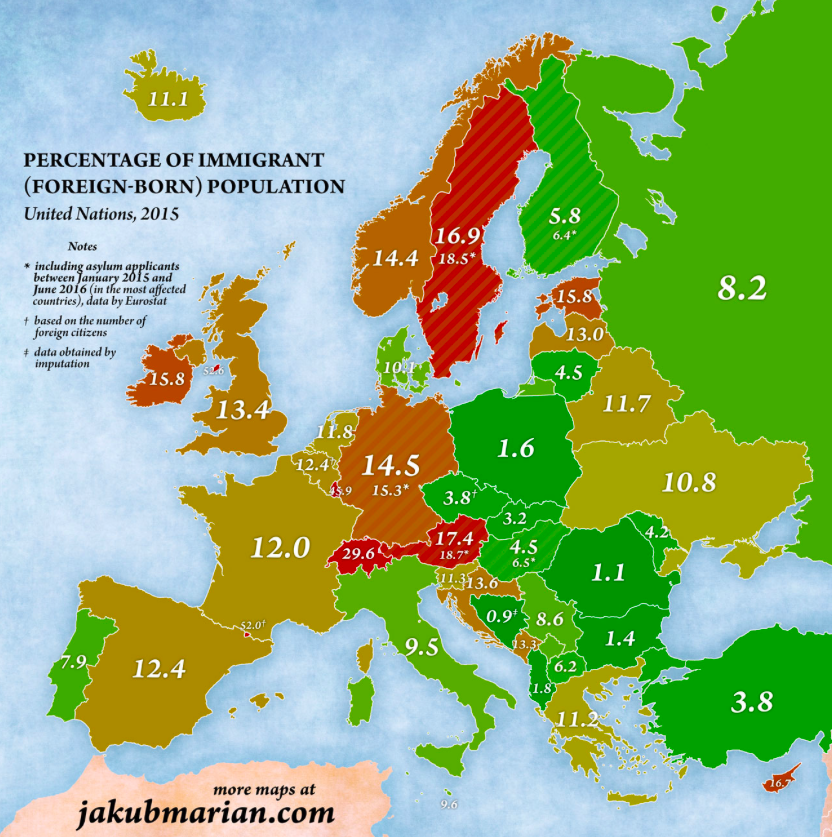
In Czech Republic there are almost 517,000 foreigners which is about 4,7% of the population.

The top three groups of foreigners are from Ukraine, Slovakia, and Vietnam.  The next largest groups are from Russia, Germany, and Poland.

In Brno, there are over 30,000 of us here and we come from more than 150 countries.

©jakubmarian.com
Like Czechland, the top three groups of foreigners in Brno are from Ukraine, Slovakia, and Vietnam.  In Brno, the top three groups make up almost half of all of the foreigners.

Maybe I should start saying "Czechkraine" instead of "Czechland".

Joking aside, this is a great place to be.  Czechland is one of the most peaceful countries to live in.  It's one of the cheapest countries to live and retire in.  And it has both the lowest unemployment and youth unemployment rates in the EU.

Saturday, January 20, 2018

Republic of South Africa

South Africa is the southernmost country in Africa.   The country is huge!  It stretches from the South Atlantic to the Indian Ocean and it's almost twice as big as Texas.  It borders Namibia, Botswana, Zimbabwe, Mozambique, Swaziland, and it completely surrounds Lesotho.

The Republic of South Africa is home to almost 56 million people.  There are three capital cities.  Pretoria is the administrative capital and where countries keep their embassies.  Bloemfontein is the judicial capital and Cape Town is the legislative capital.  Johannesburg is the country's largest city.

South Africa has some of the world's oldest archaeological and human fossil sites.  The first Europeans arrived in 1652 and there were many power struggles between the Boers (Dutch descendants), British and local tribes.  In 1910, the Union of South Africa was established.  In 1961, the country left the British Commonwealth and became a republic.

In 1948, the National Party came to power and instituted its apartheid policy that increased the racial segregation that began under Dutch and British colonial rule.  All people were classified into one of three races which allowed the white minority to enjoy the highest standard of living in Africa while the black majority was completely disadvantaged.
Apartheid finally ended in 1991.  The first universal elections took place in 1994.  The African National Congress (ANC) won by an overwhelming majority and has been in power ever since.

South Africa is a multiethnic society with about 80% of the population having Sub-Saharan African ancestry.  The country has eleven official languages: Afrikaans, English, Ndebele, Northern Sotho, Sotho, Swazi, Tswana, Tsonga, Venda, Xhosa, and Zulu.  The four most spoken first languages are Zulu, Xhosa, Afrikaans, and English.

South Africa has the second-largest economy in Africa and the 34th largest in the world.  Along with Brazil, Russia, India, and China, it is the fifth of the "BRICS" which is the association of five major emerging economies.  However, there is still a high rate of poverty.  The Rand is the national currency.

It is a country of firsts.  It is the first country in the world to explicitly prohibit discrimination based on sexual orientation in its Constitution.  In November 2006, it became the first country in Africa to legalise same-sex marriage.

South Africa is the only country in the world to destroy its nuclear weapons.

There are about 7 million people in the country living with HIV-AIDS which is more than anywhere else in the world.

Crime is a major problem.  About 50 murders are committed every day and an estimated 500,000 women are raped each year.  There are more private security guards in the country than the police and army combined.

Here are a couple of short YouTube videos about how powerful the country is and about its corruption problem.

©Test Tube News
©Test Tube News

South Africa is way far away.  As the southernmost country in Africa it is actually closer to Antarctica than it is to Czechland.  It's about an 11 hour flight from London.  I'm going in July for a week.  I know it's a short amount of time for such a long trip but I'll just have to cram in as much as I can.  I'm flying in to Johannesburg and out of Cape Town.  At least I am right now.  Cape Town has a major water problem right now so who knows what the situation will be in July.

©CBS News

Update 2025:  Here's a short video I found on YouTube about South Africa giving up its nuclear programme.

©History Matters

Wednesday, January 17, 2018

The E's

Under EU law, E numbers, or what I call "the e's", are the codes used to identify the food additives in Europe.
You find these on food labels over here.  It can be hard enough reading an ingredient label in English.
Forget about trying to figure out Czech, Danish, Lithuanian, or Finnish.  So the e's make it way easier to understand.  All of the e's are broken down to the following groups.

E100 - 199  = Colours
E200 - 299 = Preservatives
E300 - 399 = Antioxidants & acidity regulators
E400 - 499 = Thickeners, stabilisers & emulsifiers
E500 - 599 = pH regulators & anti-caking agents
E600 - 699 = Flavour enhancers
E700 - 799 = Antibiotics
E900 - 999 = Miscellaneous
E1100 - 1599 = Additional chemicals that do not fall into standard classification schemes

Taking this Dutch mayonnaise label as an example.
E270 = Lactic acid (preservative)
E330 = Citric acid
E202 = Potassium sorbate
E160a = Alpha-carotene, Beta-carotene, Gamma-carotene (yellow-orange to brown)
E385 = Calcium disodium ethylene diamine tetraacetate

The European Food Safety Authority sets the rules on food additives, definitions, conditions of use, labelling and procedures in Regulation EC 133 / 2008.

Monday, January 15, 2018

Add 1 Challenge

It's time for me to buckle down and seriously improve my Czech.  I took private classes but those ended a couple of years ago.  While I do speak Czech everyday it's not like I'm really improving.  Yes, I can go to the grocery store, mail something at the post office or order a taxi on the telephone.
But I use the same sentences every time so it's not like my Czech is actually improving.

I've got about two years until I start getting my paperwork together to apply for Czech citizenship.  In order to apply I will have to take a test to prove my Czech is at the B1 level based on the CEFR.  My Czech, right now, is probably somewhere between A2 and B1.  But for the citizenship test I will need to have solid B1 knowledge.  So I've decided to join the Add 1 Challenge.

The goal of the #add1challenge is to hold a 15 minute conversation in a foreign language after only 90 days.  Here's how it works...

You have to pick one language that you want to study.  Then commit to a non-negotiable study routine.  My goal is to study for at least 45 minutes per day, five days a week.

Every day you record if you met your daily study goal or not.
There's a private Facebook group and a Slack channel for people to help hold each other accountable.

Along the way there are various assignments and mini-challenges.  Plus every month you need to submit a YouTube video of yourself speaking in your target language.  Everyone has to submit a Day 0 video to show what their current level is.  Then new videos at Day 30 and Day 60.  On Day 91, the final video is due where you have to speak entirely in your foreign language with a native speaker for at least 15 minutes.

I can tell that this will be quite the challenge.  I like the thought of having a goal and controls in place to help keep me motivated.  I had never made a video before so that was a new experience.  I hope to learn how to add in subtitles for my next videos.

Here's my Day 0 video.  Wish me luck!

Update:  No 60 day video.