Monday, January 17, 2011

St. Michael's Church

Kostel svatého Michala (St. Michael's Church) is a baroque Catholic church in Olomouc. It was originally constructed in the 13th century and reconstructed in 1707. Around the church are columns with the Statues of the Painful Rosary. They were built around 1735 and moved to St. Michael's around 1904. There is a Dominican monastery adjacent to the church.

The exterior is a bit plain but the interior is incredibly beautiful.


Down in the crypt of the adjoining seminary is a small prayer area and a fresh water spring.

There is a great view of the town from the top or the bell tower. The Nazis seized and melted down the original bell towers during WWII. They have finally been replaced over the last few years.
The St. Jan Sarkander bell was the first bell replaced and it is the smallest. It was dedicated in 2007 and weighs 600 kg (~1,320 lbs). It cost 400 000 Kč (~$17,925).


The second bell was also replaced in 2007. It is dedicated to St. Zdislava - the Patron Saint of Families. It weighs 800 kg (~1,760 lbs) and cost 600 000 Kč (~$26,900).


The third bell is dedicated to St. Michael - the Archangel. It was replaced in 2008. It is 1.918 kg (~4,220 lbs) and it cost 1 115 000 Kč ($51,530).


The fourth and largest bell is dedicated to the Virgin Mary - the Protectress of the Unborn. It was dedicated in 2009. It weighs 2.720 kg (~5,984 lbs) and cost 1 600 000 Kč (~$71,670).

The nice thing is that you can tour the church, the bell tower, and the crypt all for free.

Friday, January 14, 2011

New Year Provisions

I swear that I have the best friends ever. Steven & Michael sent me a Christmas/New Year's box of provisions. Thanks boys!!! They mailed it Friday, January 7th and it arrived today on the 14th. It must have just made it out of Atlanta before the snow hit. Atlanta has had a record amount of snow so I figured that my box would be stuck out somewhere at the ATL airport. This is the fastest that I've received something from the USA.

Quite the contrast to the holiday cards I mailed home. I mailed cards out December 11th. Mail between the ČR and the USA normally takes 7 - 10 days. With the holidays I figured people would get their cards sometime between Christmas and New Year's. Oh but no. People got their cards around January 8th, some even later. But at least they got them. I guess this year I need to mail cards out by November 1st.

Anyway...Steven has gotten really good at boxing things up. I could not believe just how much stuff he was able to pack. I received some fuses, a few guide books, cologne, an assortment of face wash, Jif Extra Crunchy peanut butter, hazelnut coffee creamer, Degree deodorant/anti-perspirant, black beans, a blank GSU journal, Splenda sugar packets and a new Coach leather passport cover. They even sent me over a pound of jelly beans for me to take in to work. I swear these Czechs at IBM have gotten addicted to jelly beans. I may have to ration these out in order to make them last. Just saying...they do take up a lot of room in a small box.

Monday, January 10, 2011

Carmen

Carmen is my favorite opera. Written by Georges Bizet, the story takes place around 1820 in Seville, Spain. Carmen is a beautiful Gypsy with a fiery temper. She pursues a soldier until he falls in love with her but then she leaves him for another man. The soldier because so jealous that he kills her in the end. The story may sound a little harsh but the music is just incredible.

Claudia knew that Carmen is my favorite and, for Christmas, surprised me with a ticket. Yeah!! The opera was yesterday. We met some friends at Janáčkovo divadlo (Janáček Theater) for drinks before the show. This performance had a lot of energy and the music was great.

The operas in Brno are pretty good and people normally come from as far as Vienna because the performances are good and much cheaper than in Austria. . The only drawback is that the subtitles are only in Czech. So if an opera is in French or Italian, with Czech subtitles, then you had better research the story before you go.

Thursday, January 6, 2011

New Year's 2011

Silvestr is what Czechs call New Year's Eve. That's because it's the feast day for St. Sylvester (Pope Sylvester I) who died on December 31, 335.

New Year's Eve has never really been my favorite time to go out. There's just way too much drinking. Don't get me wrong...I'm not against having a cocktail and Lord knows I've had a few wild & crazy times in my day. But New Year's always seems like the night when normally, sane people all decide to overdo it at the same time. Plus, this is the night when people who normally don't drink and drive...all of a sudden think that they know how to. That's one good thing about the ČR...they don't play around when it comes to drinking and driving. Here the blood alcohol content (BAC) level is 0.00 whereas in the USA it is 0.08. I think the Czechs have the right idea on this one.

Anyway...so I'm fine to just stay at home on Silvestr. But my friends all thought that was the craziest thing they had ever heard. So I went over to Katka¨s and Robert's place to hang out with friends and play games. It was my first time ever playing Taboo entirely in German.

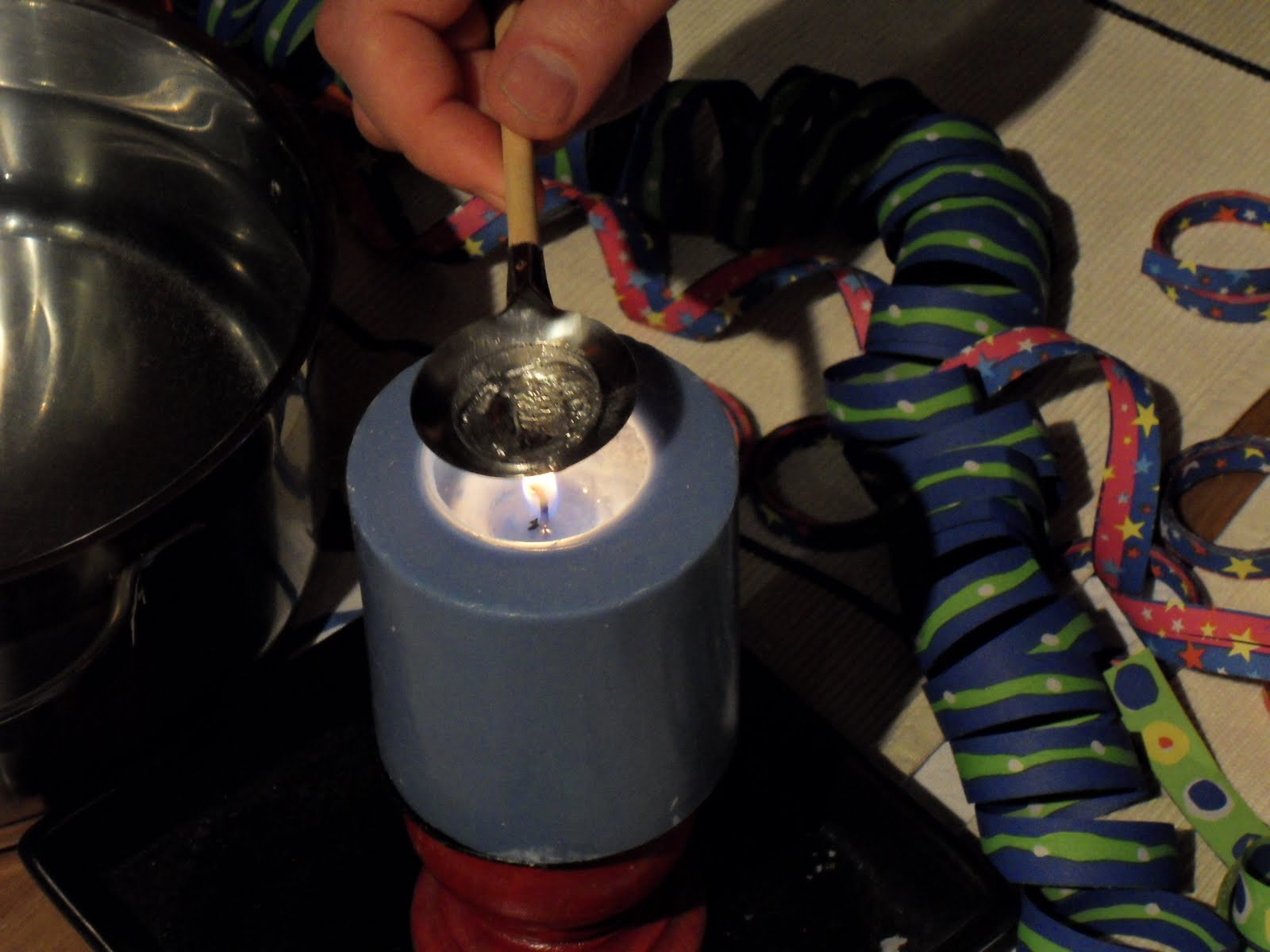
Robert is German and one of the old customs in Germany is Bleigießen. You melt lead, in a spoon, over a candle. You then pour the molten metal into a bowl of cold water. As soon as it hits the water the metal solidifies into odd shapes. The shape of the metal is supposed to tell one's future.

For example, if it looks like a tree then your abilities will grow. And if it looks like a rock then a lot of work is waiting for you. Mine kind of looks like a guy in a gondola which means that I will have an adventure. So we'll see what this new year brings.

On January 1st there was a fireworks show at Špilberk Castle which I was able to watch from my balcony.


Friday, December 31, 2010

Břeclav, Czech Republic

Břeclav is a small border town about 55 km (~34 miles) southeast of Brno. It sits on the Dyje River at the Austrian border and is about 10 km from Kúty, Slovakia. It is an important railroad hub between Prague/Brno, Bratislava, Vienna and Poland.

Since it is so close to Austria, this is where a lot of Czechoslovakian citizens risked their lives trying to escape to the West during the days of communism. The town has a population of around 26,000 people. The other day my friend, Aleš, gave me a tour of his hometown.

In Břeclav, we went to the former Jewish Synagogue that now serves as part of the town museum and is used sometimes for concerts.


The Neo-Romanesque building, with its Neo-Moorish interior, dates back to 1868. There was an exhibition upstairs about the Jewish community in Břeclav from 1414 until WWII.


The St. Rochus Chapel in the center of town was built in 1892 in memory of a cholera epidemic.


St. Mary parish church in Poštorná is a Neo-Gothic church built from 1895-1898 with special bricks from a local factory.


St. Wenceslas parish church is a contemporary church built from 1992-1995. It was built on the spot of a Baroque church that was destroyed during the war.


Here's the town's sugar factory...way back when and today.


Near Břeclav is the Lednice-Valtice cultural-natural complex which has been a UNESCO World Heritage Site since 1996. At the end of the 19th century, the House of Liechtenstein transformed the local area into a landscape park with a chateau in Valtnice and another in Lednice. Between the two are various pavilions, such as the Reistna Colonnade. During the Spring and Summer it is very popular to rent bicycles and ride between the two. I had a nice time seeing what I could but with the limited amount of daylight I could only see enough to know that I have to go back in the Spring. So when the weather warms up I'll make it back to Břeclav, Lednice and Valtice again.

Update: This is my 300th post since starting this blog. Wow!!!

Monday, December 27, 2010

Carp, Duck and Ostrich

I've survived my three days of Christmas dinners. On the 24th I had my first Czech Christmas carp. My friends, Katka and Robert, invited me over for dinner which was very sweet of them. But to be honest I was a little nervous. The traditional Czech dinner on the 24th is fish head soup followed by fried carp and potato salad. Not exactly the ham and turkey I'm used to in the U.S.

Katka laughed when I told her I was nervous about the soup. Fish head soup?!?! I had visions of lifting my spoon from the soup bowl and coming up with an actual fish head. Apparently, the head is only used to flavor the soup while cooking. Who knew? By the way, the soup was really good.

Katka wanted to try something new this year so instead of frying the carp she wrapped it in bacon and baked it. Normally carp tastes like mud to me. But if you soak it in either milk or beer then it's fine. In fact, Katka's bacon carp was quite tasty. And Robert made a potato salad with pickles and red bell peppers. My contribution was a pecan pie.

On the 25th, my American friend Scott came over for dinner and to hang out. I planned to cook a chicken and some side dishes. Well, I thought I had bought a chicken. But it turns out that "Kacsa" is the Hungarian word for duck. Again, who knew? It turned out pretty well, especially considering I've never cooked a duck before.

On the 26th, I went to Sabine's for St. Stephen's Day. That girl can whip up some French food. Five courses and everything was so dang good! Plus, it was the first time I had ever tried ostrich.

So in three days I had my first Christmas carp, my first Christmas duck and now my first Christmas ostrich. I gotta' say that the sandwich I'm having for dinner tonight just seems rather boring in comparison.

Friday, December 24, 2010

Christmas Carp

It's the 24th, so it is Christmas Day in the Czech Republic (but the 24th is Christmas Eve in the USA). That means it is time for Christmas carp. Or as I call it...bathtub fish. I explained last year that about a week before Christmas the vendors start selling fish in barrels. Traditionally people pick out the carp they want and then take it home and let it swim around in the bathtub until the 24th. This still freaks me the hell out. However, I understand it a bit more this year. I've been told that, back in the days of communism, there were shortages and you never knew if you would be able to buy what you needed. Sometimes all of the carp would be sold out days before Christmas so you had to buy it when you could. But you for sure did not want to keep it in the refrigerator for too long or it would go bad. So the smart thing to do was to let the fish live in the tub for a few days. OK...so this does start to make a little more sense. What I don't understand is how do people take a bath everyday with a carp swimming around in the tub. Some people have told me that you put the fish in a bucket while you bathe and put the fish back in the tub as soon as you are done. This is just so not my cup of tea. I would have to scrub out the bathtub before I got in it. When you select your carp at the fish vendor you have the option of taking it home alive or they will cut it for you on the spot. It seems that nowadays more and more people only take a live fish home if they have young children. My friend Aleš lives in Břeclav and his mom took a live carp home. His parents are fortunate enough to have a second bathtub downstairs so they didn't have to share the tub with the fish. He was nice enough to send me a couple of photos of what will eventually be Christmas dinner.

Thursday, December 23, 2010

Popelka

It's Christmas time in the ČR which means that there are lots of Czech fairy tales on TV. One of the favorite stories shown during Christmas is the 1973 film Tří Oříšky pro Popelku, Three Hazelnuts for Cinderella. Popelka is the Czech Cinderella.

I never knew that there were different versions of the Cinderella classic. In this version by Božena Němcová, there is no fairy godmother and there is only one wicked step-sister. Popelka finds some magic hazelnuts and receives three wishes. This Cinderella is a little more independent and does not simply fall in to the the prince's arms. Here, he has to actively pursue her.

The interesting thing about this film is that it was made as a joint venture between Czechoslovakia and East Germany. Czech and German actors spoke in their own language and the content was dubbed into either all Czech or all German for distribution.

The story is cute and I found a copy on DVD for 50 Kč (~$2.50) that has both English and Czech subtitles so I can use it to practice my Czech. Here is a clip of the film that I found on YouTube.

Update:  In East Germany the movie is called Drei Hasselnüsse für Aschenbrödel.  So in the east, Cinderella is "Aschenbrödel" but in the west she is called "Aschenputtel."

Wednesday, December 22, 2010

Sabine's Birthday

Yesterday was Sabine's birthday so a few of us went out to dinner to celebrate. With it being Christmas week a lot of people were already out of town but we had a nice time.

We started off in a wine bar for a drink and then went next door for a great dinner at Koishi, by far the best sushi place in Brno.

One thing that I don't understand over here is going out for someone's birthday. In the ČR, (Slovakia and Germany too), the tradition is that when you invite people out for your birthday, you (the birthday boy/girl) pays for everyone.

This is the exact opposite of how we do it in the USA. I'm used to all of the guests paying a little extra so that the birthday person does not have to pay for anything. After all, it's that person's birthday. Why the hell should you have to pay for everyone on your own birthday? Natalie said that they do it the US way in New Zealand too.

Sabine tried to pay since she invited us out for dinner. But we weren't having any of that. Fortunately, Natalie, Mariya and I were able to convince her into letting us buy dinner.

Wieliczka Salt Mine

The Wieliczka Salt Mine is about 20 minutes outside of Kraków. It is one of the world's oldest operating salt mines. The story goes that this is the world's 14th-oldest company still in operation. Table salt has been produced here continuously from the 13th century. In 1996, commercial mining was discontinued due to flooding in the mines and because salt prices were too low to make it profitable.

In 1978 the mine was placed on the original list of UNESCO World Heritage Sites. Over one million people visit the mine each year.

The mine reaches a depth of 327 meters (~1,073 feet) and it is more than 300 km (+186 miles). The guided tour covers 3.5 km which is less than 1% of the mine's passages.

The statues in the mines were carved out of rock salt by the miners. The detail in the statues is impressive. Even the chandelier crystals are made of salt.

Inside the mine are a couple of chapels and a lake. There is even a large cathedral inside the mine that was completed by three men. It is incredible!