


Here are a couple of videos I filmed at the festival.
 Yesterday we went to Petrov, about 4 km (2,5 miles) southeast of Strážnice, to celebrate his friend Verča's birthday.

The wine cellars form a street with two squares and is frequently visited by wine tourists. In the past, local farmers weren't able to build wine cellars under their houses due to the high groundwater level. So instead, they set up cellars on a slope a short distance behind the village where it wasn't suitable for cultivation.

 Kája's birthday was three week ago but we've been busy with work so we decided to celebrate later. I surprised him with a wellness weekend in Hustopeče.

 The area was settled by Germans in the 13th century who called it Auspitz and its first mention was in 1247. The Germans brought viticulture to the area. From the start of the 14th century to 1599, Hustopeče was owned by St. Thomas's Abbey in Brno.
 In 1572, Hustopeče was given town status by the Holy Roman Emperor Maximilian II. It belonged to the House of Liechtenstein from 1599 to 1848. In the mid-18th century, Hustopeče was Moravia's largest wine-growing municipality.
Following WWI, and the end of the Austro-Hungarian Empire, the area became part of the newly independent Czechoslovakia. After the 1938 Munich Agreement, which gave the Sudetenland to Germany, the Nazis took over. It then became part of the Protectorate of Bohemia and Moravia.
 The 1910 census indicated that most of the town's inhabitants were ethnic Germans. After WWII, the German-speaking population, even those who lived here prior to the Nazis, were expelled due to the Beneš decrees.


A lot of the almonds goes to making mandlovice (almond brandy). The almond version of slivovice.

 The town's main landmark is the Church of Saints Wenceslaus and Agnes of Bohemia. The church was built in 1994 on the site of the original church that dated back to the early 14th century.


The Žumberák fountain dates back to 1595. It used to be one of the town's few sources of drinking water.
 |
| Town Hall |
The Neo-Renaissance town hall was built in 1906.
 |
| Dům U Synků |
 The House of Lords of Vizovice was built from 1488 to 1492. It was renovated in 2002.
 T.G. Masaryk, the first president of Czechoslovakia lived in Hustopeče from 1861 to 1868. There is a 2 km (1.25 mile) trail that can be followed to see places associated with the family.

 The earliest known Jewish community in Hustopeče was during the 15th century. The Jewish cemetery dates back to 1886 with the last known burial taking place prior to 1942. During the German occupation the cemetery was vandalised, and later the Communists removed all of the gravestones in the 1980s. Now there is just a memorial plaque for the town's Jewish population that perished during the Holocaust.


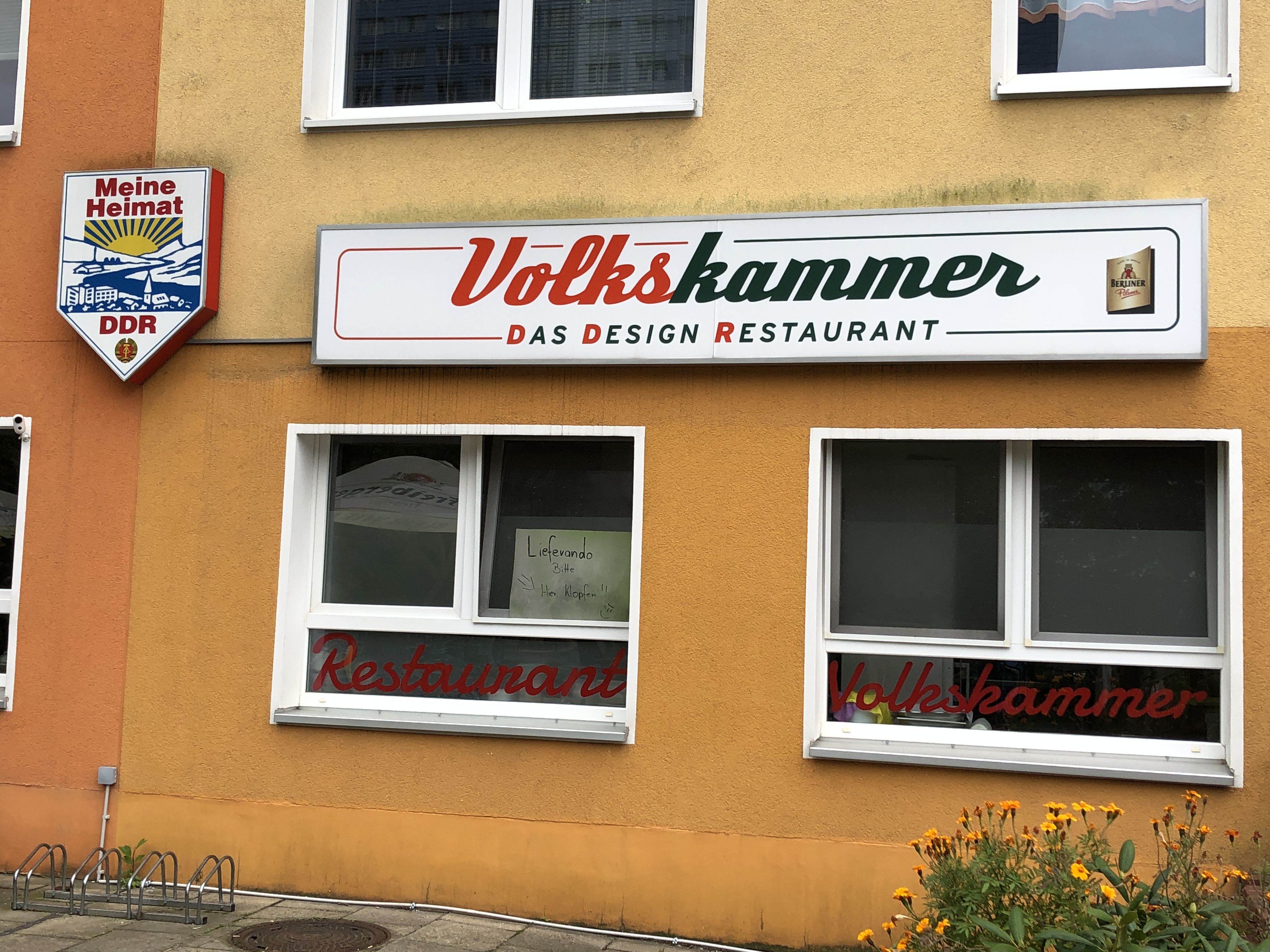 After visiting the German Spy Museum and a bit of shopping, Claudia and I had lunch at the Volkskammer restaurant. This is the DDR (German Democratic Republic) themed restaurant that we didn't have the chance to visit last time. The post about East Germany and the video about the restaurant is here.
 The restaurant is named after the Volkskammer, the People's Chamber, which was the country's single legislative body. Think of it as both Parliament and Senate (or Congress and Senate) in one. The restaurant is a kitschy place for Ostalgie, which is nostalgia for eastern times, and good, filling Eastern German dishes.
 Würtzfleisch, "seasoned meat", is a fine ragout of meat, mushrooms, in a roux of butter and flour that is seasoned with Worcestershire sauce and lemon with cheese melted on top and served with toast. Claudia remembered the aluminium cutlery from her youth and was surprised to see it still in use.
 Jägerschnitzel, "hunter's schnitzel" in Western Germany is a veal or pork cutlet, coated in breadcrumbs, fried and served with a mushroom sauce and usually potatoes.
The closest thing we have this in the USA would be "country fried steak", which is also called "chicken fried steak" which is pork (not chicken) coated in breadcrumbs and fried. It is usually served with a white country gravy. It is very popular in the south and it's believed to have been brought to America by German immigrants.
 Due to the often limited availability of goods, people had to get creative in the east. Instead of using pork or veal, Jagdwurst sausage (think of baloney or Mortadella) was used. It's a cooked sausage made of pork that is seasoned with salt, green peppercorns, ginger and coriander. It can be eaten cold or hot and is often used in soups. Instead of the mushroom sauce and potatoes as in the west, Jägerschnitzel in the east was served with tomato sauce and spiral noodles. Below is a recipe for Jägerschnitzel that I found online from the DDR Museum.
 Dessert was a Schwedeneisbecher which is a cup of vanilla ice cream with apple mouse, Eierlikör (strong eggnog style liquor) with whipped cream. Very tasty but afterwards I felt like I was going to explode from so much food. When we left they gave us mini packs of Knusperflocken. Yum!!
Ostalgie is a real thing. When the Berlin Wall came down people wanted western products. Also most of the eastern products were produced in outdated factories and the communist ideal that everyone had a job wasn't exactly compatible with capitalism so many factories in the east simply shut down especially as well-trained people quickly moved west in search of better opportunities and higher salaries.
 There are a few Ossi brands that did survive the fall of communism including, thank goodness, my favourite Spreewäldergurken, the world's absolute best pickles.
 Knusperflocken, "crunchy flakes", used to be called "Schoko-Ossis" and they've been back on the market since 1995. They are ground crisp bread and milk chocolate. They are highly addictive. Give me a cold glass of milk and I can finish off a whole bag on my own. I like the original milk chocolate kind, but now they also have dark chocolate and white chocolate versions too.
 Bautz'ner Senf is made in Bautzen, Saxony, and it was the most popular mustard in East Germany. It's still available and I often receive it my care packages from Claudia's mom. I actually use it as the base, along with honey, brown sugar and a bit of orange juice as the marinade for the ham I make every year for Thanksgiving.

Rotkäppchen is probably the most well-known brand to survive East German communism.
In 1856 some friends set up a wine store and the following year it became a sparkling wine factory. In 1894 they needed a new name so taking inspiration from the red crown cap, and from Little Red Riding Hood, Rotkäppchen sparkling wine came about.
In 1945, following the war, the company was nationalised and it was the market leader in the DDR days. Following German reunification, sales collapsed and the brand almost disappeared. In 1990 it became a limited liability company and the firm made the important decision to invest in new equipment. The company was privatised in 1993 and by 1995 it was the best selling sparkling wine in eastern Germany. By 2001 it was the best selling sparkling wine in all of Germany. I can even buy it in my little local Brněnka.
Here's a short, interesting video I found out on YouTube. I need to go check out this shop next time.
Here's the recipe for Hunter's Schnitzel with Tomato Sauce from the DDR Museum in Berlin.
Ingredients for the schnitzel:
.jpg) Valtice is small Moravian town near the Austrian border. It is part of the Lednice-Valtice Cultural Landscape which is a UNESCO World Heritage Site.
Valtice is small Moravian town near the Austrian border. It is part of the Lednice-Valtice Cultural Landscape which is a UNESCO World Heritage Site.
.jpg) The 14th century chateau was built as the main residence of the Dukes of Liechtenstein.
The 14th century chateau was built as the main residence of the Dukes of Liechtenstein..jpg) Construction on the Parish Church of the Assumption began in 1631. It took almost 40 years to complete. In 1992, two new bells were presented by the bishop to celebrate Valtice's 800th anniversary.
Construction on the Parish Church of the Assumption began in 1631. It took almost 40 years to complete. In 1992, two new bells were presented by the bishop to celebrate Valtice's 800th anniversary..jpg) |
| Valtice town hall |
.jpg)

 There were only a few people in traditional costumes and there wasn't too much folk music. The emphasis here really seemed to be just with the food vendors. This has to have been one of the smallest, low-key festivals that I've been to in the past +5 years. I think that it was fine for my parents because they had nothing to compare it to but I wish they would have seen something more.







 Posts
All Comments
Posts
All Comments


 Czech Koruna Exchange Rate


