Monday, May 8, 2017

Cologne, Germany

Cologne, or Köln in German, sits on both sides of the Rhine River.  It is about 45 km (28 miles) from Düsseldorf and 25 km (16 miles) from Bonn.  Köln is the 4th largest city in Germany with over 1 million residents.  There are over 3,57 million people in the greater metro area.

The area was first founded in 38 BC until the Romans made it Colonia in 50 AD.

Rebuilt in 1971, here's the side portal of the north gate when the city was Colonia Claudia Are Agrippinensium, around 50 AD.

There were once 12 medieval city gates that protected the city.  The restored 13th-century Hahnentor at Rudolfplatz is one of the three still standing.

The original Eau de Cologne is 4711 was created in the early 18th century by an Italian living in Cologne.  It has been produced in the city since at least 1799.

The Köln City Museum documents the life in the city from the Middle Ages up until today.  It is housed in a former weapons armoury which was built around 1600.

There's a charming old town with lots of breweries, pubs, and restaurants.
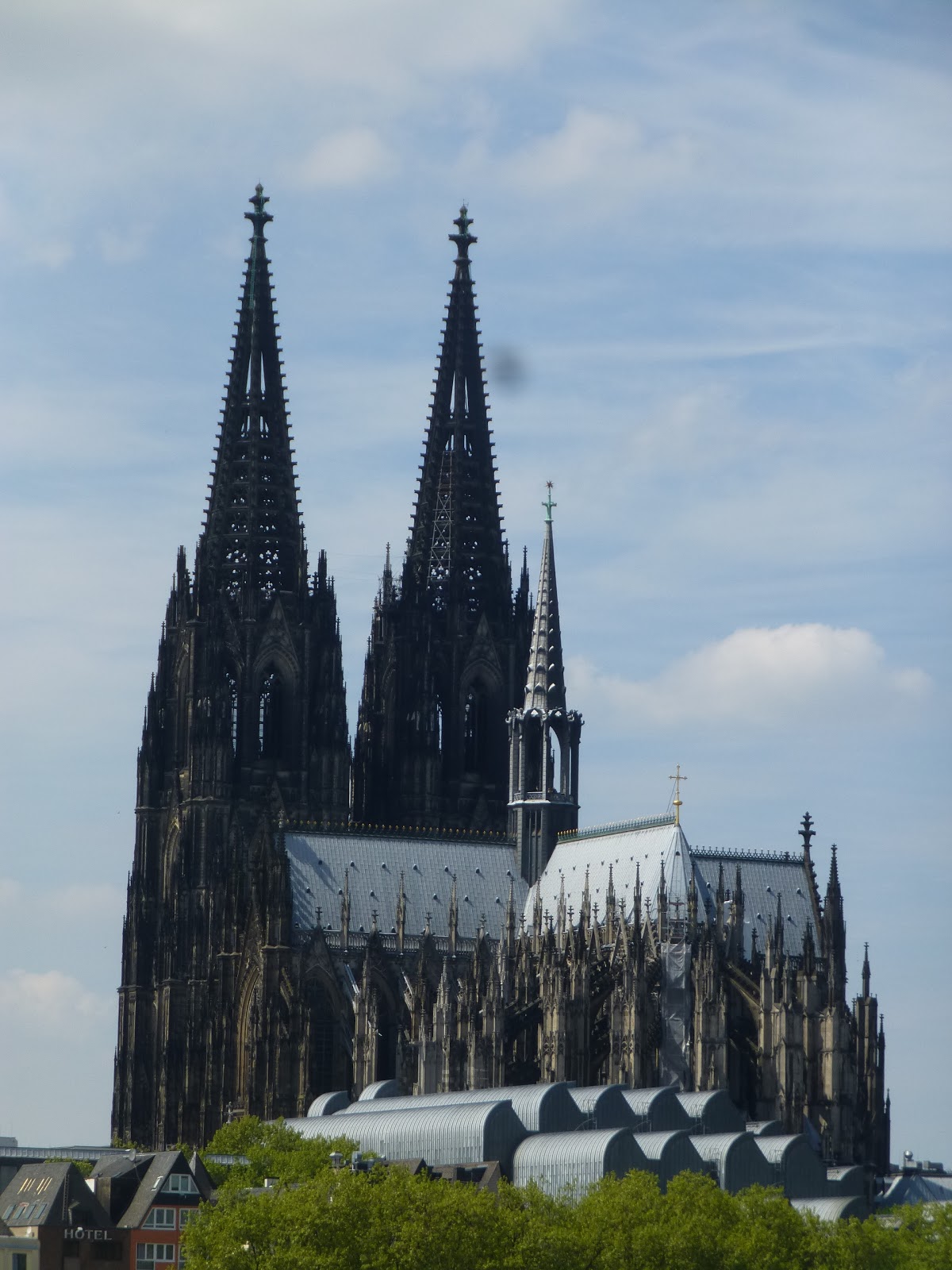
The Roman Catholic cathedral is the most visited landmark in Germany.  It is the largest Gothic church in Northern Europe.

Construction began in 1248 and was left unfinished in 1473.  It was finally completed in 1880.  It was declared a UNESCO World Heritage Site in 1996.


The city hall is over 900 years old which makes it the oldest city hall in Germany.


The Roman-Germanic Museum was established in 1946.  It's an archaeological museum and moved to its current building in 1974.


The National Socialism Documentation Centre was founded in 1979.  It is the country's largest regional memorial site for victims of the Nazi regime.  The building is a former Gestapo prison.


The Great Saint Martin Church dates back to around 960 AD.  The tower was built between 1150 - 1250.  Restoration work was completed in 1985.


The Deutz Abbey was a Benedictine monastery founded in 1003.  It became a parish church in 1804.  It was restored in the the 1970s and today it functions as an old people's home.


Along the promenade on the west bank of the Rhine are the crane tower buildings.  They are shaped to look like hosting cranes.


The Ludwig Museum opened in 1976.  It's a modern art museum featuring many works by Andy Warhol and Roy Lichtenstein.  It is also home to one of the largest Picasso collections in Europe.


On my day trip here on Saturday from Düsseldorf I joined in on one of the city's free walking tours which was quite well done.
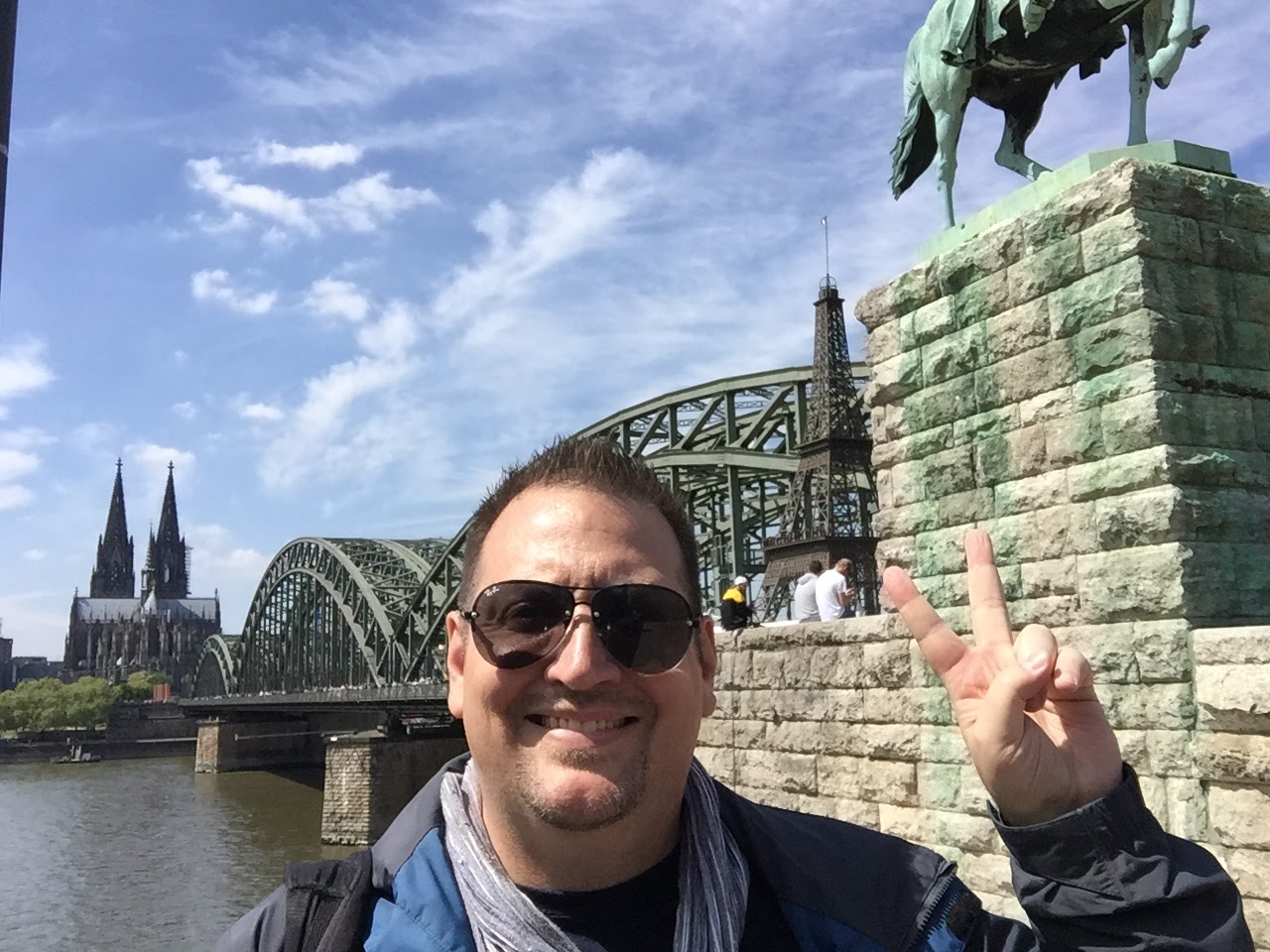


One thing's for sure and that's that one day here isn't near enough time to see everything.  Köln and Paris are currently co-hosting the 2017 Ice Hockey World Championships so the city was incredibly packed with people cheering for their favourite teams.

Here's a short DW video I found out on YouTube sharing some of the city's highlights.

©DW English

Sunday, May 7, 2017

Düsseldorf, Germany

Düsseldorf is the 7th biggest city in Germany.  Over 612,000 people live here but the surrounding metro area is home to around 11,3 million people.  Located in western Germany, it sits on the east side of the Rhine River and is less than an hour from Cologne and bit further from Bonn.

In 1288 it was granted town privileges by Count Adolf VIII of Berg and today it is the capital of the German state of North Rhine-Westphalia.

Düsseldorf is known for its architecture, fashion, and trade fairs.  Karneval kicks off each 11 November with colourful costumes and parades.

For some reason, after London and Paris, it is home to the third-largest Japanese community in Europe.

The Altstadt is a charming area with well-preserved buildings including the town hall that was built in the 1570s.  The equestrian statue was erected in 1711.

The nearby castle tower is all that remains of the old castle that was once here and demolished in 1888 after a fire.  The tower is home to the country's oldest maritime museum.

The promenade along the Rhine embankment is about 1,5 km and is a great walk to enjoy the city.  It opened in 1997 and it, quite cleverly, hides one of of the city's busiest roads which is below the promenade.

The Oberkassel Bridge crosses the Rhine River and was completed in 1969.

The Rhine Tower, at 240,5 metres (7,890 feet), is the tallest building in Düsseldorf.  It is a telecommunications tower with an observation deck and a restaurant.  There's a light fixture on the shaft which makes it the world's largest digital clock.

At the harbour are three buildings by Frank Gehry which were completed in 1999.  They make up the centre of media arts.

Across from them are a few other interesting buildings.  The mix of old and new architecture here really is really cool.

Königsallee, which locals call the "Kö", was laid out in 1802.  It extends along both sides of the old town moat and there's a huge Triton fountain at one end.  This is the high street as the retail and office space here command the highest rents in Germany.

The Roman Catholic Church of St. Andreas is in the city centre.  It was consecrated in 1629.

St. John's Church is the city's largest Protestant church.  It was built between 1875 - 1881.  It sustained major damage in WW2 and reopened in 1953.

Here's a short DW video I found out on YouTube highlighting the city.

©DW English

Tuesday, May 2, 2017

Republic of Korea

The Republic of Korea, 대한민국, sits on the Korean Peninsula, divided along the 38th parallel.  South Korea has around 3,000 mostly small and uninhabited islands.  It's only land border is with North Korea, along the DMZ, while it is separated from Japan by the Korean Strait and the Sea of Japan.

South Korea is home to 51,18 million people.  The county is a little larger than Indiana but a bit smaller than Pennsylvania.  Seoul is the capital city and has over 9,77 million people.  That's almost as many people in all of Czech Republic.

Following the Korean War, the south was a bit worse off than the north economically as North Korea was the industrial base.  During the 1960s, South Korea's GDP per capita was comparable to poorer countries in Africa or Asia.

That's a thing of the past.  From 1961 to 1979, the south's rapid economic growth saw the per capita income rise to around 17 times that of North Korea.  South Korea is an economic powerhouse and in 2004 it joined the trillion-dollar club of the world's economies.


The currency is the Won (₩).

Everyone speaks Korean.  The alphabet is incredibly easy to learn but it ends there.  The rest of Korean is difficult as hell.  Korean is more difficult to learn to speak than Czech.


South Korea hosted the 1988 Summer Olympic Games and, with Japan, co-hosted the 2002 FIFA World Cup.  In 2018 it will host the Winter Olympics in Pyeongchang.

Here's a video I found out on YouTube about how powerful South Korea is.

©TestTubeNews

South Korea and the EU have a free trade agreement in place.  South Korea has become the EU's 8th largest trade partner and the EU's is Korea's 2nd largest exporter destination.  Czech Republic and Slovakia have built significant ties with South Korea.

South Korea is the Czechland's third largest business partner outside of the EU.  In 2015 the two countries signed a strategic partnership agreement to expand business ties.  Korean Airlines and Czech Airlines have multiples per week between Prague and Korea.  All of the signs in Prague airport are written in order of English, Czech, Russian and Korean.

Here's a short video highlighting the economic ties between Czechland and Korea.

©Arirang News

I think that Slovakia has done even better.  For trade and investment, Korea is Slovakia's number one partner in Asia.  There are more than 80 registered Korean companies in Slovakia that employ over 10,000 people especially in the car and electronics industries.  KIA Motors is the biggest Korean investor in Slovakia.  When driving on the highway in Bratislava you'll see the SlovaKIA billboards which is brilliant marketing.

Monday, May 1, 2017

Korean Peninsula

The Korean Peninsula is made up today of North Korea and South Korea.  But it used to just be Korea.

The Three Kingdoms of Korea fought amongst each other until they were finally unified.  The Joseon Dynasty was established in 1392 and it 1897 it proclaimed the Korean Empire.

Following the Russo-Japanese War, Korea was occupied by Japan in 1905.  Japan formally annexed the entire Korean Peninsula in 1910 which ended the Korean Empire.  Under Japanese control the Korean identity was suppressed.  The Korean language was not to be used and Koreans were forced to adopt Japanese surnames.

After WWII, Japan was forced to withdrawal from the entire peninsula.  The northern half was put under the influence of the Soviet Union and the southern half was allied to the USA.

In 1950, North Korea invaded South Korea.  The USA and other allies fought with South Korea.  While the Soviets provided money and weapons they did not send soldiers.  Chinese soldiers fought with the north and the Korean War lasted three years.  Technically the two countries are still at war because only an armistice was signed.

Communist North Korea is officially the Democratic People's Republic of Korea, or DPRK.  The capital and largest city is Pyongyang.


Democratic South Korea is the Republic of Korea, or ROK.  Its capital and largest city is Seoul.


Here are a couple of pretty short videos I found on YouTube that talks about the history of the Korean Peninsula and the division between North Korea and South Korea.

©Foreign Policy Association

©WonderWhy

Night time in North and South Korea
North Korea is one of the most isolated countries on earth and, one day, I would actually like to go visit it.  I almost did a couple of years ago but the timing didn't work out.  There is always tension between the USA and North Korea but it has been heating up quite a bit lately so I'm sure it will be years before I ever actually get the chance to go.
In October we're going to South Korea with visits to Busan, Jeju City, and Seoul.  While in Seoul we'll visit the DMZ and the JSA.  Inside the DMZ, is the the Joint Security Area (JSA) at Panmunjom where the armistice was signed.  The JSA is under the control of the United Nations and inside the main conference room you are technically inside North Korea.  Not a real visit but this will be as close as I get for quite some time.

In anticipation of the trip I'm trying to refresh the few words of Korean I know.  I just hope that my Czech doesn't get me confused.  The last time I was in Crete and Cyprus, there were a few times that I wanted to say "no" and instinctively I said "ne", which is "no" in Czech.  But in Greek, "nai" means "yes".  
In Korean, "ne" is "yes" but it means "no" in Czech.  The Korean word for "no" is "ani-yo" which may mess with me because in Czech "ano" means "yes" while "jo" means "yeah".   Yeah, I know it's confusing.

One thing that I didn't know was just how easy the Korean alphabet is.  It was created by King Sejong in the 15th century so that everyday people could read and write.  It is a phonetic alphabet so it's not like Chinese where you need to learn thousands of characters.  Korean has 14 consonants and 10 vowels.  There are a couple of other bits but basically you just piece the sounds together to write out the words.  It's really pretty easy.    
I'm not actually learning Korean.  My goal is just to be able to read the subway and street signs.  Anything else I can read out but I won't know what I'm saying.  Here's a short video showing just how easy the Korean script is.

©KoreanEnglish101.com

Update 2025:  Here's a short video I found about why didn't Korea reinstate its monarchy after WWII.

©History Matters

Sunday, April 30, 2017

People's Republic of China

In October is our long-awaited trip back to Asia.  After last year's visit to Hong Hong and Macau we wanted to check out China.  Pretty much everyone needs a tourist visa to visit China and for Americans it costs $140.  However, if you're only stopping through Beijing on your way to another country then you can visit the city for up to 72 hours visa free.  The plan is to spend three days in Beijing and then it's on to South Korea.  So here's a bit about China.  

The People's Republic of China, 中华人民共和国, was established in 1949 as a communist state after more than two decades of civil and international wars.

China is the largest country in Asia and the fourth-largest in the world after Russia, Canada, and the USA.  It borders Afghanistan, Bhutan, Burma, India, Kazakhstan, North Korea, Kyrgyzstan, Laos, Mongolia, Nepal, Pakistan, Russia, Tajikistan, Vietnam, plus the Special Administrative Regions of Hong Kong and Macau.

Geographically China covers five time zones but the entire country is on China Standard Time which is GMT+8.

China is slightly smaller than the USA (counting Alaska and Hawaii).  With over 1,379 billion people it is the world's most populous country.  Beijing is the capital city and Shanghai with more than 23,7 million people is the largest city.

China is home to one of the world's earliest civilisations.  China was traditionally ruled by dynasties which were basically hereditary monarchies.  The last dynasty was replaced by a republic in 1912.  There was a civil war between the Nationalists and the Communists that was interrupted by WW2.  However, it continued after the war until the Communists took the mainland in 1949 and the Nationalists fled to Taiwan.  Here's a short 3-minute video I found out on YouTube about the Chinese Civil War.


In 1978, economic liberalisation began and has given China one of the world's fastest-growing economies.  It is the world's largest exporter and the second-largest importer of goods.  China is a permanent member of the U.N. Security Council.  It also has the world's largest standing army.  Here's a video about how powerful the country is.

©Test Tube News

The official name of China's currency is Renminbi which translates to "the people's currency".  A unit of Renminbi is the Yuan (¥).
China is a huge country and it is home to around 290 languages.  The Beijing dialect of Mandarin Chinese is the official language.  About 70% of the country's Chinese speakers speak Mandarin. The written characters have been used for thousands of years.  Even if people speak two different versions of Chinese, and can't understand each other, they can still communicate and be understood through writing.  Traditional characters are still used in Taiwan, Hong Kong, Macau, and overseas Chinese communities.  Simplified characters were introduced by the government in 1956 to replace the traditional ones.
  
In 1979, China implemented its one child policy in order to deal with its growing population.  In order to address the country's now rapidly ageing population and economic needs, as off 2016, couples are now allowed to have two children.
China has recently been building new islands in the South China Sea for military bases which are causing territorial disputes with neighbouring countries.  Here's a bit more detail about it.

©Vox

China and Czechland have pretty good relations.  The presidents of each country have visited the other over the past couple of years and there's a strategic partnership agreement in place.  Here's a bit more about the economic relationship.

©CCTV

Plus there's the Great Wall of China which is probably the best known symbol of the country.  No visit to China will be complete without a stroll along the wall.

Update 2025:  Here's a short video I found on YouTube about how China acquired nuclear weapons.

©History Matters

Saturday, April 29, 2017

Tünde's 4th Birthday

It's hard to believe that Tünde turned four years old this week.  So today's adventure was her birthday party at Jump Park - the first trampoline park in central Europe.


Jump Park is actually a lot of fun.  There are trampolines connected to one another from wall to wall.  There's even a back area where you can jump or flip in to a foam pit.  It's quite the workout and it sure does take a lot of energy to keep up with a group of kids who all want to play.

We got there a little early so Tünde got to have a few minutes running around by herself before everyone else arrived.


Instead of a birthday cake we went to Cupcakekárna and picked up an assortment of cup cakes for everyone.  They were a big hit.
I should look at having a team building at Jump Park although probably without the cup cakes.

Sunday, April 23, 2017

Museum of Romani Culture

Today's adventure was a visit to the Muzeum romské kultury, Museum of Romani Culture.  Located here in Brno, it the first and only, museum of Romani culture in Central Europe.  It was founded in 1991 and in December 2000 it moved to its current location in the centre of Brno's Roma neighbourhood.

Roma community flag

The museum's permanent exhibit focuses on the life, culture, and history of the Roma, with an emphasis on Czechland from 1945 to 1989.

The Roma are the people that, growing up in the USA, we would call Gypsies.  Cikán is the Czech word for Gypsy.

©Test Tube News

The Roma came from Northern India and came to Europe about 1,000 years ago.  Today, there are about 12 million Roma across Europe but the highest percentages are primarily in Romania, Bulgaria, Hungary, and Slovakia.  In Czech Republic only about 1,96% of the population is Roma.

The Roma face a lot of discrimination no mater where they are.  In communist Czechoslovakia there was a state policy of forced assimilation and there were many counts of sterilisation for Roma women designed to reduce the Roma population.  Some cases of sterilisation were reported up to until 2004.

Here's a video I found out on YouTube that talks about the Roma in Czech Republic.  The interviews are with Romodrom, which is a Czech Republic based Roma advocacy group.


The museum s quite interesting and well worth a visit.  Here's a video about the museum that they put up on YouTube.
©Muzeum romské kultury

Saturday, April 22, 2017

Kometa Wins!

HC Kometa Brno is the local professional ice hockey team and they play in the Czech Extraliga.  On Wednesday night they won the top domestic league title.  The last time Kometa won was 51 years ago during the 1965-1966 season.

The club dates back to 1953 when it was founded as an Czechoslovak army club then called Rudá hvězda Brno, Red Star.  

In 1993, the Czechoslovak First Ice Hockey League split up following the Velvet Divorce and the Czech Extraliga was formed.  There are 14 teams in the league which is the top-level league in the country.

HC Kometa Brno has won 12 Czechoslovak, and Czech, championships and 3 European Cup titles.  They placed second in the league in 2012 and in 2014.  Ice hockey is a big deal here so there has been a lot of celebrating (i.e., drinking) going on since Wednesday when they beat Liberec for the championship.

I've only been to one Kometa pre-season match against St. Petersburg which was a lot of fun.  It's quite difficult to get tickets to matches as Kometa fans are very loyal.  Even when they're not playing well it's damn near impossible to score tickets.

There was a procession in the streets today and a big rally in the centre for the players.

Monday, April 17, 2017

Brown Eggs vs. White Eggs

Happy Easter Monday!!  Veselé velikonoce!!

It's Easter time which means that it's easier to find white eggs in the market.  When I first moved to Brno, almost eight years ago, all I ever saw in the market were brown eggs.  Not very conducive for Easter egg colouring.

Over the years, it seems that white eggs have become more common.  I can find them if I look for them but I still think that brown eggs are the default here.

I know that in the USA, brown eggs cost more than white eggs because there white eggs are definitely the default colour.


I've honestly never looked to see if there's a price difference between brown eggs and white eggs in here in Czechland.  I just always buy brown eggs.