Thursday, February 9, 2012

Steluta's Going Away Party

Tonight we had a little farewell bash for Steluţa. After more than five years here in Brno she has decided that now's the time for her to return to Bucharest.


Several of us got together this evening for a nice little dinner party at a local place. We've been busy collecting photos for Katka who turned them in to a very professional looking photo album chronicling Steluta's time in Brno.

We also chipped in and got her a must-have expat survival tool - a new Kindle. Now every time she picks it up she will think of us.

It's sad to think of her no longer being here in Brno. Of course, I'll get to see her this July when I go to Romania and Moldova for my birthday.

Saturday, February 4, 2012

Hungary

I've been to Hungary twice so far. In 2010 I spent a weekend in the capital Budapest and last year I visited Győr. Next week I'm off to spend a weekend in Székesfehérvár so here's a bit about the country.

Hungary has almost 10 million people and is located in Central Europe. The landlocked country borders Austria, Croatia, Romania, Serbia, Slovakia, Slovenia, and Ukraine. Hungary is slightly smaller than Indiana.

In 1000 A.D., Hungary became a Christian kingdom and served as a buffer against Turkish expansion in to Europe. Eventually it became part of the Hapsburg Empire. As part of the Austro-Hungarian Empire, it was a superpower before it was defeated in WWI. Hungary joined the Axis Powers and found itself on the losing side of WWII. After the war, the communists took control and Hungary joined the Warsaw Pact.

In 1956, there was a revolt against communist rule which was put down by Russian tanks. During the mid-1980's Hungary's economy began to open up, in what was called "Goulash Communism". The first free elections were held in 1990 and today it is a parliamentary democracy. In 1999, Hungary joined NATO and it joined the EU in 2004.

It seems that other countries always have a problem with Hungarians. After WWI, the borders changed and many ethnic Hungarians found themselves living in other countries. The same thing happened after WWII. Today there are tensions in Slovakia between Slovaks and its nearly 10% ethnic Hungarian minority. Romania also has issues with its large ethnically-Hungarian population. Vojvodina, is the northern province in Serbia and it too has a large Hungarian presence. I suppose this is what happens when you end up on the losing side of two world wars. It probably doesn't help that the Hungarian language is distinctive and not comprehensible to anyone else. To me, Hungarian just sounds like Klingon. Of course, the Hungarian government tends to instigate trouble such as now offering Hungarian passports to all ethnic Hungarians living outside of the country, like to Slovaks, Romanians and Serbians living just over the borders.

However, right now the biggest problem is its economy. Only about 50% of the working age population is currently employed. Then last year, the government basically re-nationalized the private pension system by redirecting funds from the required private pension scheme to the state in order to pay off government debt. Now the government is in trouble with the European Central Bank over how it's handling its Swiss mortgage crisis.

Back in 2005, mortgages written in Swiss Francs were around 4% while interest rates in Hungarian Forints were in double digits. At the time, one Franc got you 160 Forint so roughly 2/3rds of Hungarian mortgages (~$22 billion) were taken out in Francs. That was fine when the Franc was weaker but after the global financial crisis and the problems in the Eurozone, the Franc has gotten stronger and the Forint has dropped 40% in value. One Franc is now about 243 Forint.

Monthly mortgage payments increased 40% and people owed more than they had originally borrowed. So the government began offering fixed rate loans (at 180 Forint to the Franc) to people in order to keep them from defaulting on their mortgages. But this scheme forces banks (mostly Austrian banks - like mine) to assume the losses from this artificial exchange rate.

Well, I've had fun the last two times I was in Hungary so I'm sure I will enjoy next week's visit. Maybe my little bit of tourist money will help out the local economy.

Update 2025:  Here's a short video I found on YouTube about why was Hungary punished so badly after WWII.

©History Matters

Thursday, February 2, 2012

Wetting the Baby's Head

One of my Ukrainian colleagues and his wife recently had their first child - a boy - David. This is celebrated by "wetting the baby's head". My first thought was that there was going to be a christening of some sort. I'm glad that I asked first.

What this means is that the proud father takes people out to consume large amounts of alcohol in order to celebrate the new arrival. It's kind of like a baby shower except that it takes place after the baby is born, it is more for the father than the mother, and there is a lot of drinking involved.

Dmytro rented a private room in a pub, for last night, where there was a continual loop of baby photos playing on the video screen. We all brought baby gifts for little David. Then every five minutes or so someone made a new toast to the baby. Since I had to work this morning I knew to just keep nursing my beer and not get too wrapped up in the hot chilli-infused Ukrainian vodka shots.

I've gotten much better at this whole metric system thing. Except for last night. In the USA, if someone says their baby is X lbs Y oz and is however many inches long then it makes sense to me. But when Dmytro said how many kilograms and centimeters his son was, I just wasn't able to make the connection. Oh well, I guess I just need to keep at it.

Last night was a lot of fun. I even got the opportunity to use my Russian again but I'm sorry to say that it has turned to complete rubbish. I don't think that I'm smart enough to handle two Slavic languages. The more I study Czech the more my Russian slips away. At least it was fun to try to use it again, and it never stops being fun for me to see the look of surprise on people's face when they come across an American who can actually speak more than just English.

Friday, January 27, 2012

2011 Census Results

Last year, the ČSÚ - Český Statistický Úřad (Czech Statistical Office) conducted the 2011 Population and Housing Census. It takes a while to compile all of the data and the final numbers will be published in Q3/2012. However, here are some of the more interesting preliminary results.

The population has increased. Yes, there is an increasing birth rate but it's mostly because there are more foreigners living in the ČR. In the last decade the number of foreigners has increased more than 260%. There are almost half a million of us here now.

The largest number of foreigners come from Ukraine, followed by Slovakia, Vietnam, Russia, Germany and Poland. The majority of foreigners live in Prague.

What Americans call "nationality", the Czechs refer to as "citizenship" and what Americans call "ethnicity", is referred to here as "nationality". So in the USA my nationality is American and my ethnicity is Mexican. But here my citizenship is American and my nationality is Mexican. Good grief this gets confusing sometimes!!

A greater number of people opted out of declaring their nationality. The largest number of people who did declare it are Czech (Bohemian) - 6.7 million. The second largest group is Moravian (522,474 people) and Slovaks came in third with 149,140. Almost twice as people claimed to be Moravian then they did 10 years ago. The vast majority live in South Moravia.

There is a big increase (46.6%) in the number of people with a university degree. Prague has the highest number of university degrees. Every fifth person in the capital has a university degree. While the number of high school dropouts has decreased there are 24.6% more people in the country who have not attended school at all.

Society is getting older. There are more people over 65 and the number of children (up to age 14) is decreasing.

Divorce is on the rise and fewer people are getting married. I've been told that under communism, it was quite often for people to get married at 18 and start having kids because this helped you get an apartment from the government. It looks like now people, who do get married, are waiting until they are older.

For the first time, same sex couples were able to state registered partnerships on the census. Since it's new there is no way to compare the data but it was declared by 2,055 people.

Fewer people answered the optional question about religion. Ten years ago, less than 1 million people skipped the question while this year 5 million chose not to answer.

The largest religious groups were the Roman Catholic Church (over 1 million), the Evangelical Church of Czech Brethren (+50,000) and the Czechoslovak Hussite Church (+39,000). Over 700,000 people said that they were believers but not belong to any registered churches.

I don't know if it was a massive joke or not but over 15,000 people said that Jedi (from Star Wars) was their religion. About 4,000 of them in Prague. I would think that this is a joke but there was also an increase in Canada, New Zealand, Australia, the UK, etc. So who knows??

Wednesday, January 25, 2012

The Vietnamese

Believe it or not, there are a lot of Vietnamese in the Czech Republic. At over 61,000 people, the Vietnamese are the 3rd largest immigrant community, after Ukrainians and Slovaks. To Americans, 61,000 may not seem like a lot but there are only about 10.1 million people in the entire country.

The Vietnamese began coming over here during communism when the Czechoslovak government invited them here as guest workers. Vietnam encouraged this because they hoped that people would return with new skills and training. After the iron curtain fell, many Vietnamese decided to remain here rather than go back to communist Vietnam.

Unable to speak Czech, the first generation here has traditionally made livings as street market vendors. Since Asian culture emphasizes the group dynamic, plus the whole Czech language issue, many Czechs view the Vietnamese as a closed off society of people who live here but are not really a part of Czech society. However, the second generation has a reputation for high levels of educational attainment and over the last few years, a significant number have opened up their own businesses.

Czech Airlines even flies from Prague to Hanoi, 2 - 3 times per week.

I've heard that there is a really good Vietnamese farmer's market here in Brno where you can get fresh coriander (what they call "cilantro" over here) and hot peppers. I really need to check it out sometime.

Friday, January 20, 2012

Herna Bars

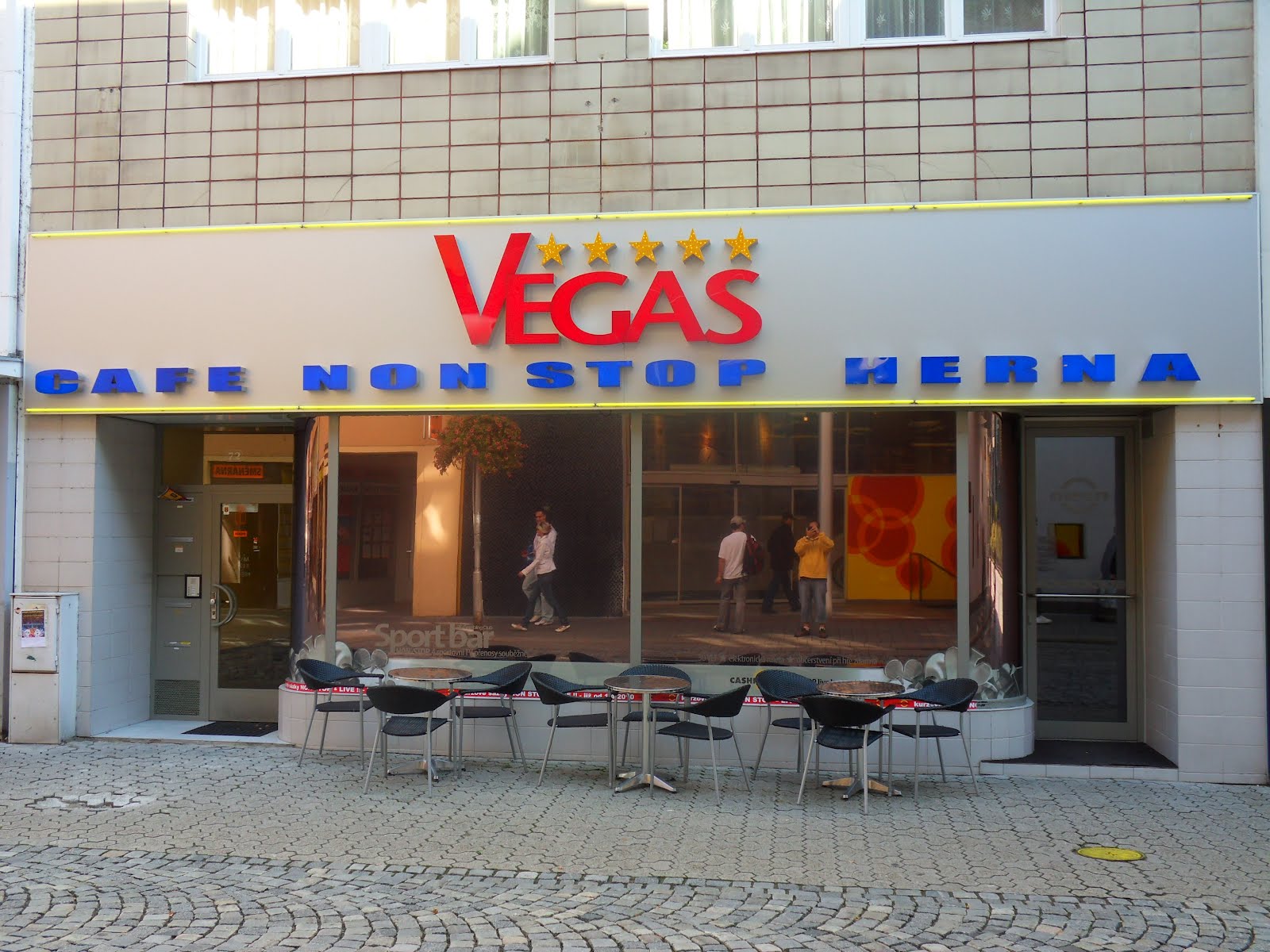
Czechs must love gambling. Back in 2007, Czechs bet 90 billion crowns (+$4 billion). The country has around 130 casinos. There are +50,000 slot machines in the ČR. That's about 1 machine for every 200 people. In addition to the casinos, there are lots of herna bars that you find all over the place. A herna bar is a non-stop place where you can go play slot machines and roulette while drinking cheap beer. I haven't actually been inside of one yet but from the outside they either look seedy or totally cheesy. I can just picture middle-aged alcoholics drinking, while sitting in a smoke-filled room, and gambling away their hard-earned wages. Don't get me wrong! I love to visit Las Vegas and I do enjoy my blackjack. But, I doubt that the inside of a herna bar will remind me too much of Vegas. But who knows?

Thursday, January 19, 2012

2012 VAT Increase

V.A.T. (Value Added Tax) is what Americans would call sales tax. There are two different rates. Everyone used to pay 20% but there was a reduced rate of 10% on food, medicines, newspapers, books, heating, water and public transportation. Well, that was until the start of 2012. Now, everything costs more!

In order to reduce the debt, and given the current Eurozone crisis, the Czech government has made changes to the VAT. The goal is to have a standard flat rate of 17.5%. So this year, the reduced 10% rate increases to 14% and the 20% rate remains the same.

Then in 2013, the 14% rate will increase to 17.5% and the 20% rate will drop to 17.5% so that everything will be taxed the same. At least, that's the plan for now. Somehow I have a feeling that by 2013, everything will be taxed at 20%. Of course, I hope that I'm wrong.

So the bottom line is that now people are paying more taxes. The cost of groceries is now 4% higher than what it was a few weeks ago. And I just renewed my public transit pass and it cost me more this year than before. I wonder what kind of effect this will have on pensioners? I'm sure that they will really feel the pinch because it's not like their benefits have increased.

Note:  VAT increased in 2013 too.
Update: In 2021 the VAT is 21%.

Sunday, January 15, 2012

2012 New Year's Brunch

Everyone has been really busy over the last couple of weeks so I decided a New Year's brunch was long overdue. Especially since many of us were all traveling at New Year's. So this morning everyone came over to my flat for an American style breakfast.

Miran was here this weekend and went with me yesterday on my scavenger hunt for maple syrup. Note to self...bring back maple syrup when you visit the USA this September. The only syrup we could find at Tesco was imported from Canada and, at $12 for 375 ml (12.8 oz), it was pricey. But a necessity for American pancakes.

Yes! American pancakes.
Here in Euroland what they call "pancakes" aren't really pancakes. In the USA, we would call them crepes and they are usually filled with cheese, fruit or chocolate. Don't get me wrong. These paličinky are very good but they are definitely not pancakes. Anyway...we had plenty of food, great company and it was wonderful to have everyone together. Now to keep up the momentum of getting everyone together at least once a month.

Thursday, January 5, 2012

Slovenia's First Jewish Memorial

Between the two world wars, Murska Sobota was home to Slovenia's biggest Jewish community.

During WWII, the area was occupied by the Hungarians. On April 26, 1944, the town's 328 Jews were ordered to gather with hand luggage. They were locked up overnight, without food or water, and the next day were sent away, eventually going to Auschwitz. About 65 people survived. Today, only about a dozen Jews live in Murska Sobota.

On January 29, 2010, Slovenia's first Holocaust memorial was unveiled at the train station.

The memorial is a suitcase with a bench and an inscription that reads...

V aprilskih nočeh leta 1944 je s te postaje za vedno izginil velik del judovske skupnosti Prekmurja.

In April nights of 1944 from this station a large part of Jewish community of Prekmurje forever disappeared.

Tuesday, January 3, 2012

Comino, Malta

Comino is the smallest of the three inhabited Maltese islands, located about half-way between Malta and Gozo.

The Mediterranean island is only 3.5 square km (1.35 sq miles) in area. Today, the island is a bird sanctuary and popular with tourists in the summer.

The island population is four. Yes, four! There's a priest and a policeman that commute regularly from Gozo.

Here's a video I found out on YouTube about Salvu Vella. We actually saw him out and about on the island.

©DW English

St. Mary's Tower was built in 1618. The fortification was used as an early warning system and to improve communication between Malta and Gozo.


The main attraction is the Blue Lagoon. The water is absolutely beautiful and there is even a small sand beach. On the other side of the Blue Lagoon, only 100 meters (300 feet) from Comino, is the fifth Maltese island – Cominetto.