Sunday, October 9, 2011

Maribor, Slovenia

Maribor is Slovenia's second largest city. It's just two hours from Ljubljana and four hours from Vienna, on the way back to Brno.


So I decided to get off the train, store my luggage in a locker and explore the town for four hours until the next train came.

With a population around 158,000 it is a small town. There is a bit of construction going on now as Maribor prepares to be a European Capital of Culture in 2012.


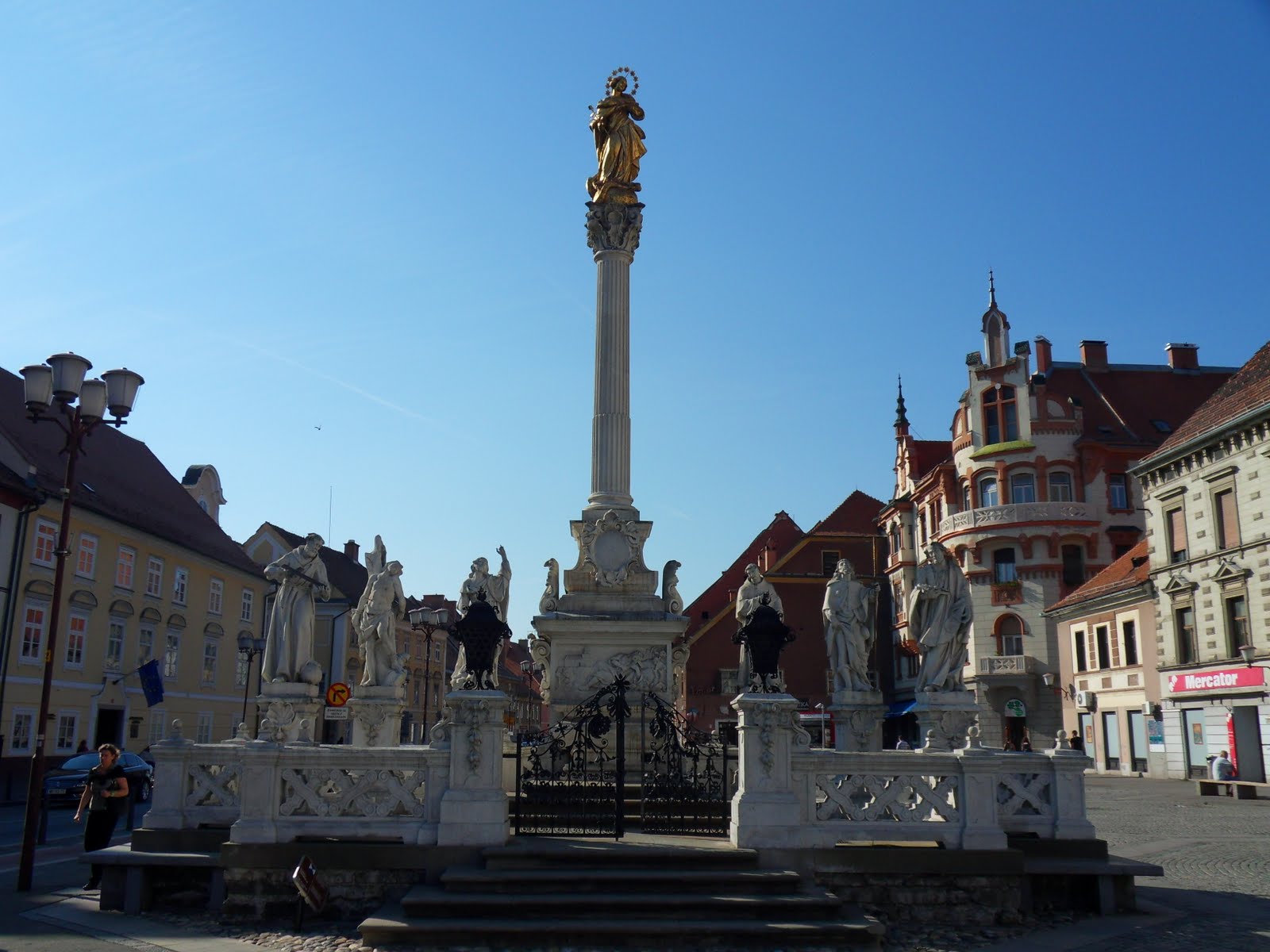
The town hall was built in 1515 and is found at the main square.


Across from it is the marble plague column built in 1743. The plague epidemic in 1680 killed one-third of the town's population.


The St. John the Baptist Cathedral is the seat of the Catholic Archdiocese of Maribor. The cathedral dates back to the 12th century.

At Liberty Square is the National Liberation monument. The bronze WWII monument was dedicated in 1975. It has graphical reproductions of old public proclamations about hostages and rebels being shot during the war. I was told that the locals call it "Kodžak" because it reminds them of the fictional, bald detective Kojak.


The Franciscan church was built from 1892 - 1900. It is dedicated to St. Mary Mother of Mercy and is the biggest church in Maribor.


The main attraction is the Old Vine. It is the oldest vine in the world that still produces grapes. It is around 440 years old and in 2004 it was listed in the Guinness Book of World Records. 440 years!?!? That means it was around when the Ottoman Turks invaded, when Napoleon's army held Slovenia, two world wars and communism. Wow!!! This grape vine is older than my country.

The one thing that I didn't get a chance to see was Maribor's synagogue. It is one of the only two left in Slovenia and one of the oldest preserved synagogues in Europe. Next time.

Wandering Earl

I met this guy Derek at the hostel, where I stayed, in Ljubljana. He was one of the people that went on the tour to Bled and Bohinj. A really nice guy.

What I didn't realize until the next day was that Derek is actually Wandering Earl. Who knew that I had been in the presence of blogging royalty?

Back in 1999, he went on a three month trip to Asia and the trip has yet to come to an end. OK, so my little blog is basically just my diary. I started it so that I would not seem so far way from my family when I moved over here to Euroland. Wandering Earl's blog is a right, proper travel adventure.

Be sure to check it out here. He has had some pretty amazing adventures. Wait until you read about the time he got kidnapped in Bangledesh. Crazy!

Update:  Cool deal! I got mentioned in a Wandering Earl post about Bled.

Saturday, October 8, 2011

Bled, Slovenia

The good folks at the hostel I stayed in arranged a small group tour for a few of us to Bled. It's about an hour (55 km) from Ljubljana and is a major tourist attraction. The town is over 1,000 years old. It is best known for the island in the emerald green lake, its castle, stunning scenery, and some sort of cream cake.

The place is so beautiful! The glacial lake is surrounded by forests and the Julian Alps. Slovenia only has one island and it's here. The only way to get to it is by row boat. Somehow I ended up rowing the six of us over to the island. I'm still not sure just how that happened but oh well.


From the dock there are 99 steps up to the top. The local tradition is that the groom must carry his bride up the stairs to the church and the whole time the bride must be silent.


At the top of the island is the 15th century Assumption of Mary Pilgrimage Church. Inside you can make a wish and then ring the bell three times.

Slovenia's oldest castle overlooks the lake. It dates back to the 17th century and it offers some amazing vies of the lake and the Alps. We planned to skip the castle and just hike up some paths to get a better view of the island. Well, we ended up charming one of the maintenance guys and he let us all in the back door of the castle. So we got to see everything and save the €7 admission. Sweet!

The only thing that we didn't do was go hiking along the Vintgar gorge. I'll for sure be back to do some hiking there. And to try that cream cake (somehow we missed that too).


After Bled we drove about 45 minutes to Lake Bohinj, inside Triglav National Park. It is the country's largest glacial lake. It's 4.2 km long, 1 km wide and 45 meters deep. Also known as 2.6 miles long, 0.6 miles wide and ~148 feet deep. Dang metric system.

Bohinj was far less touristy then Bled but just as beautiful. A few of us actually went in to the water for a bit. Let me just state the obvious. Glacial lake...in the Alps...YES, it was cold.

These Slovenes have it really good when it comes to beautiful scenery.

Friday, October 7, 2011

Ljubljana, Slovenia

Ljubljana is Slovenia's capital city but it is a small town with only 270,000 people. The city's symbol is a dragon and it is everywhere.

The city's architecture is a mix of Renaissance, Baroque and Secessionist. The Slovene architect Jože Plečnik left his mark throughout the city.

Ljubljana Castle is a medieval castle, built in the 12th century, which overlooks the city. The area around the castle has been inhabited since 1200 BC.


Preseren Square is the town's main square. It is dedicated to Dr. France Prešeren - the greatest Slovenian poet. There is a statue of him in the middle of the square. This is the main meeting point in the city.

The pink Franciscan Church of the Annunciation is the town's parish church. It was built between 1646 and 1660. Next to the church is a 13th century Franciscan monastery.

Plečnik's triple bridge is one of the best known landmarks in the city. The main bridge was replaced for automotive traffic and pedestrian bridges were added on both sides. In 2008 the whole area was turned into a pedestrian zone. The bridge is great but it is really tough to get a photo clearly showing all three. Even from up at the castle tower.

The St. Nicholas Cathedral is the city's main church, and the biggest. Slovenia's major religion is Roman Catholicism and the cathedral serves as the Archdiocese of Ljubljana.

The Dragon Bridge, with four green dragons, was built between 1900 and 1901. This is one of the first bridges in Europe made of reinforced concrete. Word is that the dragons waive their tails when a virgin crosses the bridge.

Tivoli Park is the largest park in Ljubljana. In the park is the National Museum of Contemporary History. The museum chronicles Slovenia from before WWI until present day. I was really interested in seeing what they had on the last twenty years, in particular the 10-day war of independence. The museum exhibits were well done and all of a sudden ended with the early 80s. Everything since then is still a work in progress. I guess a return visit is in order once the exhibits are finished.


Near the park is the Serb Orthodox Church. It was built in 1936 as the church of St. Cyril and Methodius.


The skyscraper was inaugurated in 1933. At 70.35 meters (~231 feet) tall, for a while, it was Europe's tallest residential building.


You can get anywhere in town, on foot, within 20 minutes and there are cafes everywhere. Ljubljana is a great little town. While on a free city tour a man passed us while talking on his mobile. It was Milan Kučan – Slovenia's first president. A former president walking through the center of town without body guards? Unfortunately, I didn't realize who the man was before it was too late to get a photo.

I had a feeling that I would like Ljubljana but I had no idea just how much. A return visit is a definite must.

Sunday, October 2, 2011

Plitvice Lakes National Park, Croatia

It's almost two hours (135 km / 83 miles) by bus from Zagreb to Plitvice Lakes National Park. Founded in 1949, it is the largest national park in Croatia and the oldest in Southeast Europe.

It is about 297 sq km (+73,000 acres) and in 1979 it was listed as a UNESCO World Heritage Site. The park is open all year round and receives over 900,000 visitors annually.


Plitvice is absolutely stunning!!
There are 16 lakes (12 upper lakes and 4 lower lakes) that interconnect through a series of waterfalls, all surrounded by heavy woods and mountains. It is a great place to go for a hike and lose one's self in the scenery.

The water is so clear that you can see the fish swimming. Depending on the minerals in the water and the angle of the sun, the water's color ranges from azure blue to green.

To date, 1,267 different types of plants have been cataloged in the park.

There are different paths you can take to cover the park. I elected to go for trail "H" which is the 4 - 6 hour path. From the entrance I rode the shuttle train to the upper lakes area. I hiked down to where a shuttle boat dropped me off on the other side of the main lake. Then I hiked through the lower lakes canyon and up by the great waterfall. Then it was up along the east side of the canyon until I made it back to the starting point.


I did it in about 3.5 hours. I should have taken the 8 hour path but I didn't want to take a chance on missing the last bus back to Zagreb.


Oh well, there is always next time.
I wonder how much of the lakes freeze? I would love to see the park in the winter with all of the snow and ice.

Saturday, October 1, 2011

Zagreb, Croatia

About a month ago I found a discount (700 Kč / $40) on a one-way bus ticket to Zagreb. The bus left last night at 11:30 and it took a little over six hours to get here from Brno. I was able to sleep for a while during the trip I was fine to tackle the city.

Zagreb is Croatia's capital and has around 1 million inhabitants. There are two parts to the city. The lower town has wide boulevards, large squares, parks, the botanical garden and some cool buildings. The upper town is much more historic with St. Mark's church, the cathedral, government buildings and nice views of the city.

Between upper and lower town is Ban Jelačíć Square. This is the main meeting point in the town center. The square has a large statue of Josip Jelačíć on a horse that was put in place in 1866. He was a Croatian viceroy who defeated the Hungarians in an 1848 battle. In 1947 the Yugoslav communist government removed the statue because it was thought to fan the flames of Croatian nationalism. The statue put back when Croatia declared independence from Yugoslavia.

The Cathedral of the Assumption of the Virgin Mary is the tallest building in Croatia. The neo-Gothic church can accommodate 5,000 people.

In front of the cathedral is a plague memorial.


Lotršcak Tower used to be the main city fort. It was built in the mid-18th century. Every day at noon a cannon is fired from the tower.

Zagreb's botanical garden has founded in 1890 and has over 10,000 different plants. It is a very peaceful place in the city. And the best part is that it is free to visit.

St. Mark's is an 18th century church. It's known for its multicolored tile roof featuring the crests of Croatia the city of Zagreb. Most churches tend to be more ornate on the inside than on the outside. Not so here. The outside of the church is definitely nicer than the inside. There is a regular changing of the guard performed in front of the church.

Near the church is parliament. Croatia will be the 28th country to join the EU next year. Everywhere you look in Zagreb are Croatian and EU flags together.

OK, I'm off to bed now. I have an early bus in the morning to Plitvice.