Friday, June 18, 2010

Dracula's Castle

Bran is about a 40 minute bus ride from Braşov and is a major tourist destination. It is home to Bran Castle...also known as...Dracula's Castle.

Vlad III was Prince of Wallachia. He was known as Vlad Ţepeș - Vlad the Impaler. His Romanian surname, Drăculea (Son of the Dragon), points to his father Vlad Drăcul.


He is most famous for impaling those who opposed him and for fighting the Ottoman Empire. Vlad's name inspired Bram Stoker's 1897 novel "Dracula".

In 1212, the Knights of the Teutonic Order built Bran Castle. Towards the end of the 13th century the castle was taken over by the Saxons to protect Braşov which was an important trade center.

Vlad Ţepeș used the castle during his raids in to Transylvania.


There's not a whole lot to see as far as the castle goes but the surrounding area is quite beautiful. It did take all day to get there and back but you can't go all the way to Romania and not make the trip to Bran. And now I can cross of "Visit Dracula's Castle in Transylvania" off of the bucket list.

Braşov, Romania

Braşov is the 8th most populous city in Romania. It is in Transylvania, at the foot of the Carpathian Mountains. The train from Bucharest (~200 km) takes just over 3 hours...sort of.

The train going there was delayed an hour and the train back to Bucharest was 2.5 hours late. So 4 hours there and 6.5 hours back made for a very long day. I've got to say that Czech trains are way better.

The town has some really pretty buildings and it is a popular spot with tourists.


The most famous landmark is Biserica Neagrăis, the Black Church. It is a Gothic church and the largest, most important Lutheran church in the region. It became known as the Black Church when, in 1689, it was partially destroyed by a fire set by invading Habsburg forces during the Great Turkish War.

Thursday, June 17, 2010

Herăstrău Park

Parcul Herăstrău is the best park in Bucharest. If not the most eclectic. It was opened in 1936 and is really split in to two different sections.

One part is Muzeul Satului, Bucharest's Village Museum. It is one of Europe's largest open-air museums.

It's a great place to spend a couple of hours outside as you walk around and see more than 300 buildings representing Romania's rural architectural history. Every region of the country is represented.

There are lots of old peasant houses, with some dating back to the 16th century. Plus barns, churches, windmills, etc.


The other portion of the park contains everything else. There are lots of statues and sculptures, including a giant one of Charles de Gaulle. There is an area for ping-pong, and for skateboarding. You can rent boats and go out on the water. There's even a Japanese garden.


I had to laugh when I came across the Michael Jackson memorial. First of all, it's clearly new so it hasn't started to crumble like so many of the city's monuments. Secondly, the story goes that while on one of his tours here, he yelled out "Hello Budapest". Wrong capital.

Wednesday, June 16, 2010

Palace of the Parliament

Palatul Parlamentului, the Palace of the Parliament, is the second largest building in the world, after the Pentagon. Bucharest residents still refer to it as Casa Poporului, the House of the People.

Today it houses both chambers of the Romanian Parliament.

Ceauşescu got the idea for it after a visit to North Korea in 1972. He wanted to house all government offices in one place, in addition to, being his residence. Victory of Socialism Boulevard (now named Boulevard Unirii - Union Boulevard) would be the Champs-Élysées of Bucharest and lead to the Palace. The street was deliberately designed to be 1 meter wider on each side and 6 meters longer than the Paris thoroughfare.

About 20% of central Bucharest was leveled, including 19 Orthodox Christian churches, 6 synagogues, 3 Protestant churches, 8 relocated churches and 30,000 homes.

Construction began in 1984, 24 hours per day, 7 days a week. After the revolution in 1989, work halted for about 3 months. So much money had been invested in the palace that work resumed and it was completed two years later.

This place is massive. It can be seen from the moon. A tour of building lasts about an hour and you only get to see about 3% of the building. During the tour, the guides throw out random measurements of how big it is but it didn't mean anything to me because it was all in metric. I'm getting better at metric but I'm still not so great when it comes to really large numbers like these. So here it goes...

Area: 76,000 m² (~250,000 ft²)
Height: 84 meters (~276 ft) above ground; 15 meters (~50 ft) underground
Length: 170 meters (~558 ft)
Width: 245 meters (~804 ft)

There are 1,100 rooms and each is lavishly decorated. In each room, the ceiling pattern, matches the wall pattern, which matches the floor and carpeting pattern. Almost all of the materials used come from Romania, including 1 million cubic meters of Transylvanian marble, 900,000 cubic meters of wood, 700,000 tons of steel and bronze, 200,000 m² of carpet and 3,500 tons of crystal for the 480 chandeliers. The building is incredible but it's hard to imagine all of the money and materials used for this while the people were starving.

Tuesday, June 15, 2010

Nicolae Ceauşescu

Nicolae Ceauşescu was the Secretary General of the Romanian Communist Party from 1965 to 1989. He was the last dictator in Eastern Europe and the only Iron Curtain leader to be violently overthrown.

He was a maverick who often stood up to the Soviet Union. He really became popular, both at home and abroad, when he denounced the Warsaw Pact invasion of Czechoslovakia in 1968.

Romania had long been a poor country and his policies made it so much worse for the people.

He wanted to increase the country's population so, in 1966, contraception and abortion were banned. Α 10-20% income tax was imposed on people who were childless after 25. And it didn't matter if you were single or not. Mothers of at least 5 children were entitled to significant benefits. He also made it virtually impossible to get a divorce. So with a growing population and rising poverty, the number of abandoned children, began to grow in urban areas. Orphanages were seriously overcrowded.

In order to build the perfect socialist society, over 11 million people were resettled from private houses in 7,000 villages to apartment buildings in 550 standardised "agro-industrial centers".

Ceauşescu borrowed around $13 billion from the West to finance economic development programs. In the 1980's he began exporting most of the country's agricultural and industrial production in order to repay its debts. But this created domestic shortages and caused extreme hardship for the people. Food rationing was introduced and it was common everyday to have heating, gas and electricity black-outs. The foreign debt was finally paid in 1989, right before the revolution.

Plus the Securitate, Romania's secret police, was ruthless. Relative to the country's size, the Securitate was the largest security agency in Europe.

In 1989, there was a violent revolution in Romania and the government was overthrown. Ceauşescu and his wife Elena fled the capital but were eventually caught, given a show trial and executed on Christmas Day. Footage of the trial and the post-execution were broadcast on Romanian television.

The Peasant Museum has an exhibition of communist iconography. There's really not a lot to see but there are lots of pictures of Stalin and Lenin. It was interesting to me that there is not one word or picture of Ceauşescu when he ruled the country for over 20 years. I wonder if it's because the people have had their fill of the Ceauşescu personality cult. Or maybe he is just so despised that they don't want to think about him anymore.

The BBC ran a show called "The King of Communism" that is pretty interesting. Here's the first part of the show. You can find the rest of the documentary available on YouTube.


©BBC

Monday, June 14, 2010

Bucharest, Romania

This past weekend was my first trip to Romania. The country has always kind of fascinated me. It's the land of Dracula and Nadia Comaneci. It's in Eastern Europe but the people are not Slavs. As a former Roman province, Romanian is a romance language and it sounds like a "funny" version of Italian. I remember, when I was a kid, that these were the "good" communists that stood up to the Soviet Union and attended the 1984 Olympics in Los Angeles. Yet, when the Iron Curtain was coming down, Romania's revolution was the bloodiest. So with a cheap flight out of Vienna, I figured why not go finally see it?

I should have known that something was up when my Romanian friends warned me about how dirty the city is, that I would need to be careful of pickpockets and that the countryside is where is where I should go.

It was hot there over the weekend. Around 95°F and humid. The city's metro isn't really designed for tourists. It was built to bring the workers in from the outer parts of the city. So every tourist stop was a hike from whatever the nearest metro stop was. My poor feet were so sore. Plus there was a lot of dust and dirt so by the end of the day I was ready for a shower...bad!

I had always heard that Bucharest was beautiful...that it was the Paris of the Balkans. And I could see where that was probably the case +25 years ago. Nicolae Ceauşescu, the communist dictator overthrown in 1989, did a number on the city. A massive portion of the city was torn up, including old buildings and churches, to make room for the Palatul Parlamentului (Palace of the Parliament).

Lots of people were evicted and forced to move in to the typical socialist flats. Unfortunately, lots of people now had no room for their pets and the city has a huge dog problem. Something like 50 people per day are bit and my travel guides all said that if bit, just go to the hospital within 3 days for a rabies shot. It's been 25 years already, why is the dog problem still a big deal? I did notice that about ½ of the dogs I saw had a yellow ear tag and the other ½ didn't.

Bucharest's Arcul de Triumf was built out of wood in 1922 to honor the Romanian soldiers who fought in World War I. In 1936, it was replaced with the granite version.

Ateneul Român, the Romanian Athenaeum, is the city's musical center. The 19th century building, located on Benjamin Franklin Street, is adorned with mosaics and frescoes.

Piaţa Revoluţiei (Revolution Square) is where the rebirth memorial is for the 1989 revolution. Most people don't really care for this one. I heard it called "the cocktail olive on a stick".


At Piaţa Universitatii (University Square), I found another memorial to the victims of the revolution. A lot of the memorials I saw were already crumbling in places. Pretty sad considering these aren't even 25 years old.

The Peasant Museum was OK and the Village Museum was really cool.

Parcul Carol I, is one of the nicest parks in the city. Here's where the memorial to the unknown soldier is plus tombs for WWI and WWII.


Lipscani is the historical district of Bucharest. It's where a lot of restaurants and cafés are. But most of the streets are a disaster. Apparently, while doing street repairs some archeological sites were found. So the repairs stopped and the area looks more like a war zone.

Well I can cross Bucharest off of my list of places to visit. I got to see a little bit of the country on my trip to Dracula's castle. If I go back to Romania again, I'll skip the horrible city traffic and head straight for the country.

Wednesday, June 9, 2010

Czechoslovak Commercials

I should have been studying my Czech grammar but instead I wound up on YouTube. But I don't feel too guilty because at least I was still practicing my Czech. Here is a video of some random commercials that were shown in Czechoslovakia prior to the 1989 Velvet Revolution.

The commercials have a bad 1980's retro feel to them...but oh well.
  • The plastic egg containers are still around but I've only ever seen them in clear plastic; not pink. And "No", I haven't tried stacking bricks on them.
  • I have had egg on pizza here. It's actually not bad.
  • Climatex sportswear is still alive and kicking.
  • I've seen flavored syrups in the grocery store but I haven't purchased any yet.
  • The "disco" milk commercial at the end is just tragic.

Monday, June 7, 2010

Maria Theresa

Sunday, was Maria Theresa Day at Špilberk Castle. There were people in costumes, some arts & crafts, and games for the kids.

For everyone back home, here’s a little bit about Maria Theresa (1717 - 1780). She was a key figure in 18th-century European politics.

She was the eldest daughter of Holy Roman emperor Charles VI. Due to the lack of a male heir, her father altered the Hapsburg family law so that she could inherit the lands.

She became the archduchess of Austria and queen of Hungary and Bohemia (1740–80), as well as, empress of the Holy Roman Empire. She unified the Hapsburg Empire and is considered one of its most capable rulers.

While on the throne she had 16 children, including Leopold II and Marie-Antoinette.

Sunday, June 6, 2010

Public Transit Exhibition

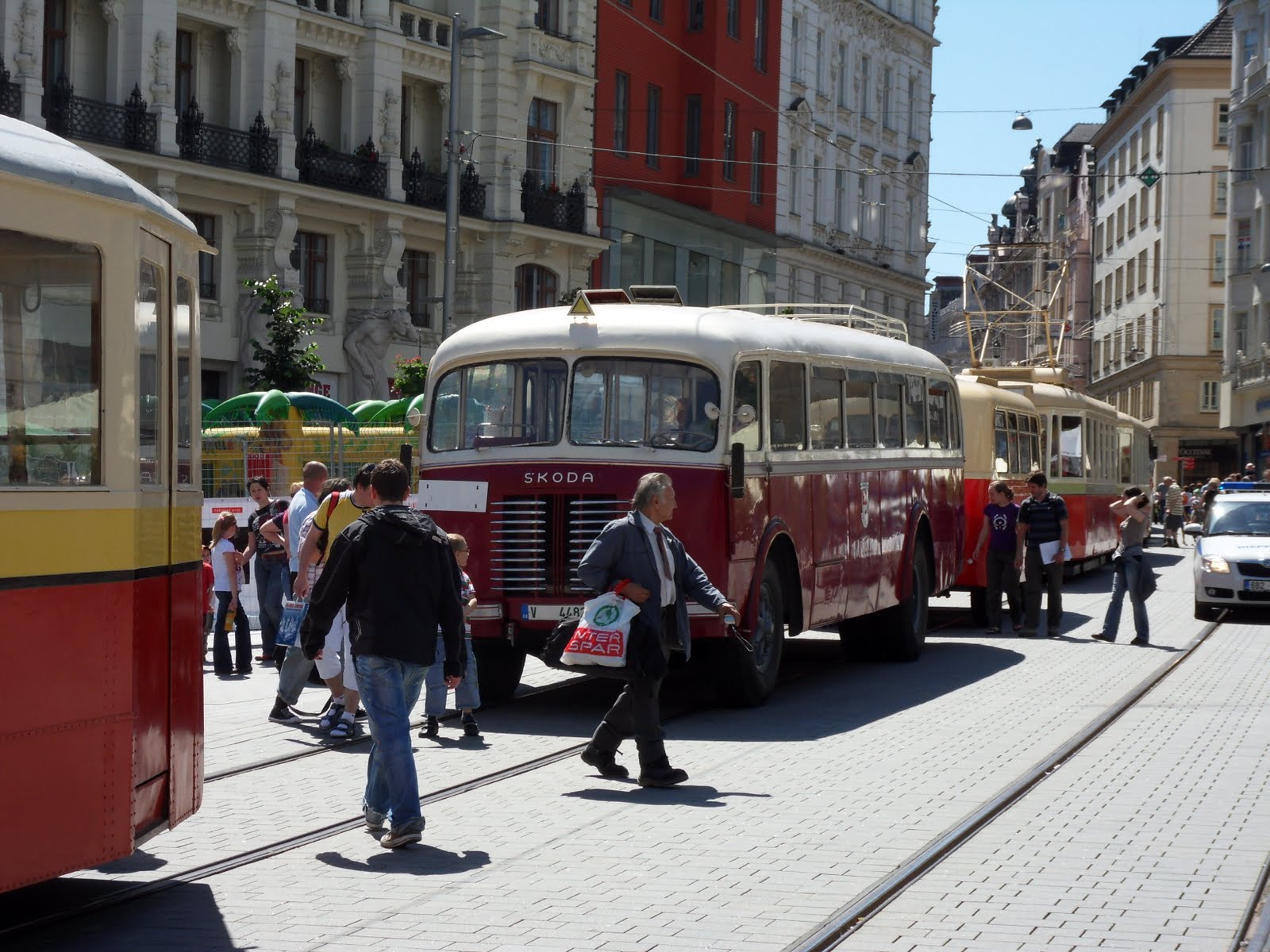
As part of the festival that included Ingnis Brunensis, there was a display of historical public transportation in the city center. I had seen the historic tram before but these were even more fascinating. It looks like the Brno Technology Museum has quite a collection. People here have been getting around via trams for 110 years. The city buses were added 80 years ago. The trams and buses were even running so people could go for a short ride around town. Both the exteriors and interiors have definitely changed over the years!