Sunday, December 2, 2012

A Hippie Christmas Party

On Friday night, we had our annual unit Christmas party.  This year's theme was a "Hippie Christmas" and it was a real blast.  I was impressed with how so many people went all out with the theme.
I took my final vacation day of the year on Friday in order to get ready for Thanksgiving.  And knowing that I had to get up Saturday morning to cook the turkey, I made sure not to over do it on Friday night.

About ½ of my current team
I did have a "three-peat".  I won the award for the best boss again.  It was very nice but it's really an easy thing to do when you've got such a great team of people to work with.  The award really should be for the luckiest boss because my team is awesome.

The party was held at the same bar as last year.  I was extra careful about my camera this year.

Friday, November 30, 2012

Thanksgiving Prep

Thanksgiving is already here again.  Well, it was actually last week in the USA but I'm celebrating it tomorrow.  Since Thanksgiving isn't a Czech holiday I normally host a Thanksgiving party on the Saturday after.  However, this year, for several reasons, it worked out better to wait a week.  Plus, it's not really like people here have noticed it's a week later than normal.

This year's boxes from Steven and Mom
Yeah for my annual Thanksgiving care packages!!  I normally get packages from Mom & Dad, in Prescott, and from Steven & Michal, in Atlanta, on my birthday, Thanksgiving and Christmas.  Which is great and they are so much fun to get.  But my favorite care packages are the ones I get at Thanksgiving because the ingredients are necessary in order to pull off a traditional turkey day fest here in Brno.

My German care package
This year, I even received a Thanksgiving/Christmas pack from Claudia's mom in Berlin.  It even came with a little Krteček advent calendar which is for my nephew in California.

Getting ready for this year's Thanksgiving has been a bit more stressful than the previous three years.  The biggest issue has been the turkey.  Last year's turkey was 14 kg (31 lb) was way too big.  So rather than deal with the halal shop again I decided to go back to our normal place in Židlochovice.  So two weeks ago I placed an order for a 10 kg (22 lb) bird.  They told me no problem and they took down my mobile number when I called them.

For some reason, I just knew that I should reconfirm everything with them again.  So yesterday, a friend called to check and they said everything was fine and they had my 7 kg (14.5 lb) turkey ready.  We reminded them that the order was for a 10 kg bird and their response was "yes, but we received small turkeys so it is 7 kg".  When asked why they didn't call to let me know about the problem their response was "what good would calling have done, the turkey is still only going to be 7 kg".  Uuuggghhh!!!!  I swear that at times Czech (nonexistent) customer service just makes me want to stick a fork in my eye.

This year's tiny turkey
At least I found out about the size issue yesterday so I had time to come up with Plan B.  Had I gotten this surprise when we went to pick it up today I'm sure my head would have spun around three times.  Although today they had a possible solution.  I could either have my 7 kg turkey or take a 15 kg (33 lb) turkey.  I elected to go with the 7 kg bird and thanks to "Plan B" we are also going to have a 5 kg  (11 lb) ham as well.  I'm sure that there will be plenty of food for the 28 people coming to my flat for turkey day tomorrow.  And the good news is that 7 kg won't take as long to cook so I don't have to get up at 5:30 AM to put it in the oven.  Which is good news because tonight I'm off to attend our department's Christmas party.  Let's hope that it isn't too late of a night because I still have lots more cooking to do tomorrow.  

Tuesday, November 27, 2012

Body Percussion #2

The body percussion session that the Alps team came up was such a hit that one of my other teams decided to do it too.  We had a few more people than last time which made it even better. 

We had the same instructor as before but he did different things so it wasn't just a repeat of last time.  Given that we all laughed so much tonight shows that this can be a ton of fun even for uncoordinated people.

Monday, November 26, 2012

Warranties

There are a few perks about living in an EU country.  One of them is that consumer goods come with a mandatory two-year warranty period.  I don't mean an extended warranty.  I mean that the minimum coverage, by law, is a full two years.  Retailers and manufacturers can still offer extended warranties beyond the two year minimum.

In the USA, you almost always have to have the receipt in order to take something back to a store.  Depending on the store policy, you can either exchange the item for another one or you can get your money refunded.  Some stores don't even require a receipt.

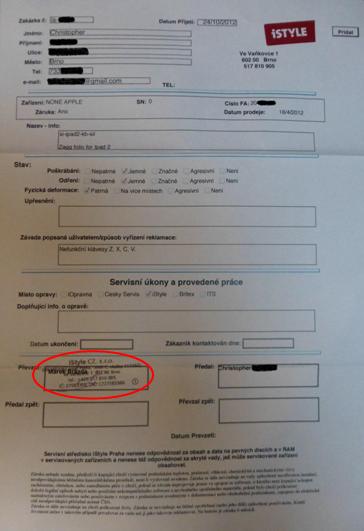
My repair invoice with a stamp & initials
Over here, it is a bit different.  When you purchase a consumer good, the sales clerk will rubber stamp your receipt and then initial it.  Other places, like government offices, also do the stamp and initial thing.  The receipt isn't valid without the stamp and clerk's initials.

A few months ago I purchased a cover, with a wireless keyboard, for my iPad.  Suddenly, the Z, X, C and V keys stopped working.  So I grabbed my receipt and took it to the store where I purchased it.  All I wanted was a new one.  Here's how it works...

The retailer has 30 days to fix the defective item.  If, after 30 days, they can't fix it then they have to give you a new one or refund your money.  I was told that the retailer gets to determine if the product is faulty or not.  No problem for me because the keys didn't work for the clerk either.  So I was given a repair invoice, with another stamp and initials, and told that the store would send it out for service.  It really would have been easier, if they had just given me a new case on the spot but that's not how things work here.

The retailer/vendor must complete the repairs within 30 days but it is up to the consumer to check on the status.  Odd...but whatever.  After 30 days, I went back to the store with my invoice.  They still didn't have any word back from the service center but I had my invoice showing that it had been 30 days.  I was told that I could get my money back or use a credit towards something else.  The store ended up giving me the new, updated version of what I had originally purchased for the exact same amount.  I wasn't thrilled about not having a case for 30 days but now I'm happy again.

Sunday, November 25, 2012

Juice

This morning I was invited over for breakfast with friends.  I was in charge of bringing over some juice.  When I went to the market, I decided against the usual flavors - orange, apple, grape, pineapple, or grapefruit juice.  I didn't even get multivitamin juice which is my favorite.  

As I was looking at the shelves I decided to mix things up a bit.  I went with apricot juice, strawberry juice, peach juice, pear juice and sour cherry juice.  I'm still reluctant to try the banana juice because I just can't imagine how exactly they juice a banana.

I've noticed that many Czechs mix juice with water.  Some have told me it is because the juice is too strong if you drink it without water.  I think it's really because they've always drunk it with water so they don't know what juice is really supposed to taste like.  Friends have told me that back in the days of communism, you had to make things last as long as possible which is why people put in just enough juice to flavor up the tap water.

Another popular thing over here is flavored syrup.  You mix a small bit with some water and you have a fruit flavored beverage.  The syrup isn't bad but given a choice I'll stick to real juice.

Saturday, November 24, 2012

Czech Names

There are all sorts of rules when it comes to names in Czech Republic.  Each day of the year has a particular name assigned to it and people celebrate their svátek (name day).  It's almost like a second birthday.  On your name day, you normally receive flowers and you are supposed to give out sweets to your friends.

For example, my name day is September 18th so everyone in the country named Kryštof celebrates on this day.  Everyone seems to know when it is someone's name day.  Names are preprinted on almost every calendar here.  Plus, florists write on the shop windows the name of the day so you know if you need to pick up some flowers on your way in to the office.

The name day calendar goes back to the 18th century and it really doesn't get updated that much.  If your name isn't on the calendar then you don't get a name day.  This helps explain why there isn't a whole lot of diversity in Czech names.

Official Czech Baby Name Book
Here are some of the most common Czech names.  (By no way a complete list)

Boys:  Dalibor, Ivo, Jakub, Jan, Jíří, Luboš, Luděk, Lukáš, Martin, Michal, Ondřej, Pavel, Petr, Roman, Tomáš, Vojtěch

Girls:  Alžběta, Anna, Eva, Hana, Jana, Kateřina, Jitka, Lenka, Markéta, Martina, Petra, Pavla, Šárka, Zdeňka 

Then there are the short names.  In English, William is often called Will or Bill.  Depending on William's age and the level of intimacy, he could even be called Willy or Billy.  It's kind of like that over here but with way more shades of gray.

Jan can be called Honza, Honzík, Honzíček, Jenda, Jeník, Jeníček, Jeňa or Janek.  Anna can be called Anka, Aníčka, Andulka, Andula, Anča, Anínka, Anína or Anuška.

Under communism, parents had to receive special permission to give a child a name that wasn't already on the Czech calendar.  Not that much has changed.  Authorities make things difficult if the child's name isn't on the official list.  Since 1989, parents can name their child whatever they want as long as the name already exists somewhere in the world.  And it must be approved by a special office in Prague which charges a service fee.

Czechs don't have middle names.  On all of my official papers here, I have to use my first name and middle name as the Czech first name just so that my documents all match my passport.

Czechs have a given name and a family name.  However, the family name is different for women.  Because the Czech language is dang complicated, last names are treated as adjectives and therefore must follow gender rules.  A man can have Novotný as his last name and his son(s) will be called Novotný.  However, his wife and daughter(s) will have Novotná as their last name.

The most common difference is -ová.  Novák becomes Nováková.  Czechs add the -ová to the last names of foreigners too.  So in the Czech press, First Lady Michelle Obama is Michelle Obamová and Madeleine Albright is Madeleine Albrightová.  Even Harry Potter author J.K. Rowling is J.K. Rowlingová over here.

I would think that this different last name thing would cause problems.  For example, if a single mother was traveling internationally with her male child, then the last names wouldn't match up in their passports.

Until 2004, every woman in ČR was required to adopt the feminine version of her husband's last name, unless he was a foreigner whose name ended in a vowel.  I guess foreign names ending in vowels were OK.  Since 2004, the law allows anyone who marries a foreign man to take her husband's exact last name and thus avoid the whole -ová thing.  However, there is a fee for this.

Note:  I also found out that Czechs don't do the junior or senior thing.  If Martin Veselý names his first born son Martin then they are both called Martin Veselý.  There is no Jr., or II, to differentiate between them. 

Update:  Czech name rules cause difficulties for trans people because they can only select gender-neutral names.

Update:  Legislation passed in 2021 so in 2022 women can choose whether to take -ová or not.

Thursday, November 22, 2012

Architecture Lecture

On Monday night, a few of us went to a lecture at Vila Tugendhat.  Fortunately, the lecturer was visiting from the University of Texas at Austin so everything was in English.

Dr. Christopher Long is professor of architectural and design history at UT Austin.  His presentation was "Thoughts on the Ground Plan: Spatial Ideas in Mies, Loos, Strnad, Frank and Scharoun".  Basically how each of these Central European architects contributed to modern conceptions of space-making.

I know very little about architecture and even less about modern architecture.  I was a bit worried at first that with since the majority of the 70 person crowd were architecture students that the material would go right over my head.  However, the presenter was excellent and I even learned a few things.  Not bad for only 100 Kč ($5). 

Tuesday, November 20, 2012

Dr. Fish

With all of the walking that we did in Athens, we decided to go for another "first".  Our first fish foot therapy session at Dr. Fish.  I wasn't quite sure what to expect.  But, hey, why not?  I'm all for new adventures.

We first had to wash our feet and then we put our feet in to the fish tanks.  Garra Rufa fish then gently remove dead skin and make your feet feel soft.  It was a very odd feeling at first.  It felt like your feet were on a mild jacuzzi jet. 

The fish don't have any teeth so it is painless.  They have this suction-cup mouth which they use to eat dry, dead skin.

Garra Rufa are also called nibble fish.  Actually, they are a form of carp.  The experience was fine and my feet felt great afterwards.  But I'm not so sure that I would do it again.  It definitely does not put me in a mood for Christmas carp.

Monday, November 19, 2012

Greek November 17th Protest

AP Photo/Petros Giannakouris
Greece and Czech Republic both had holidays on November 17th.  In ČR, it is Struggle for Freedom and Democracy Day.  On Saturday, Greeks commemorated a student upraising against the former military dictatorship.

In 1973, there were student uprisings, against the government, that began on November 14th.  There were several violent clashes with police on the 16th and in the early morning hours on the 17th, Greek army tanks stormed the National Technical University in Athens.  Twelve people died, more than 1,000 were injured and hundreds of people were arrested.  Greek law now forbids police and the army from entering any university campus. 

The student protests weren't enough to overthrow the government.  However, on November 25th, army hardliners overthrew dictator George Pasdopoulos.  A civilian government took over in July 1974.  Every year, tens of thousands of people march from the university to the front of the U.S. Embassy in Athens where they normally burn an American flag.  Many Greeks blame U.S. Cold War politics for backing the dictatorship from 1967 to 1974.  A similar march also takes place in Thessaloniki, the second largest city in Greece which culminates with protests at the U.S. Consulate there.
©PressTV


I received a warning from the U.S. Embassy to stay clear of the protest area.  Early in the afternoon we saw that the streets at Syntagma Square were closed off, hotels had covered up their windows and the riot police were taking position. 

We spoke with a police office who assured us that the march has nothing to do with the latest round of austerity measures.  He made it a point to let us know that nothing ever happens during this march because everyone knows that the there are over 6,000 police officers deployed.  Even still we made it a point to stay clear and find something else to entertain ourselves with.

I'm not sure what the police officer was talking about because back at the hotel I found lots of footage on YouTube from previous years and it didn't look quite as easy going as he tried to tell us.  This year, there were about 20,000 protestors in Athens and the police detained 70 people.

Here's some footage I found on YouTube of this year's protests.


While not directly related to the November 17th memorial, I'm sure that the current austerity measures still have an impact.  This video gives you a glimpse of just how bad the financial situation is in Greece.


©Al Jazeera

The Acropolis

The most famous landmark in Athens, if not in all of Greece, is the Acropolis.  It is a flat-topped rock 150 meters (490 feet) above sea level.  The surface area is about 3 hectares (~7.5 acres).  In 1987, it was declared a UNESCO World Heritage Site.

On top of the Acropolis are the Propylaea, the Erechtheum and the Parthenon.


The Propylaea is the giant gateway that marks the entrance to the Acropolis.  It is made out of white marble with accents of grey marble and limestone.  Construction began in 437 BC.  Although not completely finished, construction stopped in 432 BC.

The Erechtheion is an ancient temple on the north side of the Acropolis.  It was built form 421 to 406 BC.  It is made entirely of marble.  The temple was built on a slope so the south and east sides are about 3 meters (9 feet) higher then the north and west sides.  The temple underwent restoration from 1977 to 1988.  The coolest feature about the Erechtheion are the caryatids - columns in the form of women.  However, these are only exact replicas.  One of the originals is in the British Museum and the remaining ones are on display at the new Acropolis museum.

The Parthenon is one of the most famous buildings in the world.  It was built as a temple for Athena, the goddess of wisdom, courage, strategy, civilization, law and justice.  Construction began in 447 BC and it was completed in 432 BC.  It's incredible that it only took 15 years to build.

In the mid-3rd century AD, there was a major fire which destroyed the roof and most of the interior sanctuary.  In the 4th century a wooden roof with clay tiles was installed but left the building's sides exposed.  In the 5th century the Parthenon was converted into a Christian church.

After Athens fell to the Ottoman Empire, it was converted into a mosque in the 1460s.  In 1687, the Turks used the building as a munitions dump and during a battle with the Venetians, the Parthenon was bombed.  The explosion caused most of the damage that can still be seen today.  

Thomas Bruce was the Earl of Elgin and the British ambassador to Constantinople (Istanbul).  In 1806, he removed many of the surviving sculptures from the Parthenon and Erechtheum.  There is doubt as to exactly how much permission he actually had from the Ottoman Sultan to do so.  In 1816, he sold the pieces to the British Museum in London, England, where they are still on display.

Some critics feel that this was basically looting and want the pieces returned to Greece.  Others feel that the pieces were saved from the inevitable pollution damage that would have occurred had they remained in Athens over the past few hundred years.  The new Acropolis museum was built specifically to counter this argument.

Over 50% of the original sculptures are currently in the museum.  There are a few pieces in the Louvre and in Copenhagen but almost half of the original art is in British Museum.  Since 1983, the Greek government has campaigned for the pieces to be returned to Athens.  However, the British Museum refuses.  The British government has been unwilling to enact legislation that would force the museum to return the artifacts to Greece.  It's all rather highly controversial.

Here's a Rick Steves video I found on YouTube that talks about the Acropolis and everything on top of it.

©Rick Steves