Wednesday, April 4, 2012

Republic of Austria

Natalie, Miran and I are planning a little Easter road trip in the Alps.  Nat and I will catch a train from Brno to Graz where Miran will pick us up and drive us to Innsbruck.  From there it's on to Liechtenstein and Switzerland before heading back to Austria.  So here's a bit about Austria.

The Republic of Austria is a landlocked country in Central Europe.  It's a little smaller than Maine.  Austria is known for the Alps – think The Sound of Music, skiing, classical music, the Waltz and rich pastries.  Austria has a population of ~8.5 million people and roughly 25% live in the capital city – Vienna.  Most Americans think of Austria as being part of Western Europe since it was west of the Iron Curtain.  However, Vienna is actually east of Prague.

In the 17th and 18th centuries, Austria was one of Europe's super powers.  In 1867, it became the Austro-Hungarian Empire.  After its defeat at the end of WWI in 1918, it became a republic.  In 1938, Austria was annexed by Nazi Germany and became part of the Third Reich until the end of WWII.  In 1955, the Allied occupation ended and Austria became a republic with a policy of permanent neutrality.

Today, Austria is one of the richest countries in the world.  It is part of the EU and Schengen, as well as, a Eurozone member.  But it is not a part of NATO.

The Austrian €1 coin with a picture of Mozart
The official language is German but there is a definite Austrian accent.  The border between the Czech Republic and Austria is only about 60 km (37 miles) away.  Due to Austria's close proximity I would expect more Czechs to speak German.  However, many elderly people here in Brno can speak some German.  Many times I've asked directions from someone older, in Czech, but they responded back to me in German.

Austria and the Czech Republic do occasionally have their share of disagreements.  For example, Austria is a very "green" country and doesn't like the Czech's Temelín nuclear power plant being 50 km from the Austrian border.  Austria even threatened to block the ČR from joining the EU if the facility wasn't decommissioned.  The treat didn't work because the Czechs joined the European Union in 2004 and Temelín is still running.

Update 2025:  Here's a few short videos I found on YouTube about the annexation of Austria and the postwar occupation.

©History Matters

©History Matters

©History Matters

Andorran Post Offices

I send six postcards back to the USA every time I go someplace.  So I always have to figure out the local postal situation when I go someplace new.  Well Andorra was a bit unusual because there is no Andorran post office.

Since Andorra has joint heads of state the country also has two postal systems.  La Poste is the French post office and Correos is the Spanish post office.  Each postal authority issues its own Andorran stamps for international mail.

You first have to decide if you want your mail processed in France or Spain.  Once you decide, you need to go to the appropriate office and purchase Andorran stamps.  When you drop your mail in to a post box you have to be sure to use the correct one.  Spain won't process letters with French Andorran stamps and France won't process letters with Spanish Andorran stamps.

Once the mail is collected it is sent off to either France or Spain for processing.  I bought stamps at La Poste so my postcards will all arrive with French postmarks.

Until 2009, domestic mail within Andorra was free so no stamp was needed.  Now locals have to purchase either French or Spanish stamps too.

Ordino, Andorra

Not far from Andorra la Vella is the small village of Ordino.  It is the main city of the largest, and least populated, parish in Andorra.

Ordino lies at the foot slopes of Mt Casamanya.  The village has around 3,100 residents.

It is a very quiet little town and a nice place to just walk around and relax.


The main sights are the postal museum and the Sant Corneli and Sant Cebrià church and bell tower.  The church was built between the 16th and 18th centuries.

Tuesday, April 3, 2012

Andorra la Vella, Andorra

Andorra la Vella is the capital of Andorra.  The capital is located high in the east Pyrenees Mountains between France and Spain.  Andorra la Vella is the highest capital city in Europe with an elevation of 1,023 meters (3,356 feet).


From Barcelona it takes +3 hours on a bus to go north the 202 km (125.5 miles).

The capital only has +22,500 residents but with all of the surrounding villages the local population is +40,000.  The main industry is tourism – especially when it comes to skiing, and shopping.

Andorra la Vella has been the country's main city since 1278 and the old town has many historic streets and buildings from this time. 


The Casa de la Vall was built in 1580 as a fortified house and has been the house of parliament since 1702.


The Església de Sant Esteve (St. Stephen) church was built in the 11th century.


The Gran Valira is the country's biggest river and flows through the capital.

There are lots of very high end shops but lots of high end prices to match.  Most of the shops closed for a few hours for afternoon siestas.  To me, it's kind of odd for shops to close in a place that is known for it's shopping but, oh well.  I wasn't really there to do a bunch of shopping anyway.


Nearby is Caldea, which at 6,000 sq meters (~64,600 sq ft), is Europe's largest spa.  It would have been great to check out the spa but sadly there just wasn't enough time for it in our quick day trip.

Montserrat, Spain

Montserrat is Catalan for "serrated mountain" and it is about 48 km (~30 miles) northwest of Barcelona.  It is the most important religious site in Catalonia.  It's an easy train ride from the city and then a cable car ride up to the top.

The Benedictine monastery was founded in 1025.  The grand basilica was constructed in 1592.  Although the monastery is home to one of the oldest, still running printing presses in the world and one of the oldest European schools for boy singers, neither are reasons why people come here.  It's to see the Virgin of Montserrat.

The Virgin of Montserrat is a statue of the Virgin Mary, holding baby Jesus and an orb.  There is a protective glass case around Mary but you can touch the orb.  The statue is one of the black Madonnas of Europe.  It was originally lighter but over the centuries it has become dark from either all of the candle smoke, the humidity or simply because the original varnish has darkened with age.  Pilgrims have been coming to see the statue since the 12th century.

Many people believe that the wooden statue was carved by St. Luke in 50 AD and brought to Spain.  It was supposedly hidden in a cave and rediscovered in 880 AD.  According to historians it was actually carved in the 12th century.

The monks could not move the statue to build the monastery so it was built around it which is why the statue is located at the rear of the chapel.  Right outside is where I was able to light a candle for my grandmother.

A visit to Montserrat makes for a nice ½ day trip.  Here's another Rick Steves video I found on YouTube to fill in any details I missed.
©Rick Steves

Monday, April 2, 2012

La Sagrada Família

La Sagrada Família, officially the Basilica and Expiatory Church of the Holy Family, is the best known landmark in Barcelona, perhaps in all of Spain.  Even though it still isn't finished being built, it is already a UNESCO World Heritage Site and in 2010 the Pope proclaimed it a minor basilica.

Model of the completed church
Construction began in 1882 and Gaudí worked on the church from 1883 until his death in 1926.  Work on the site was interrupted during the Spanish Civil War and began again in the 1950s.  In 2010, construction passed the midpoint and the estimated completion date is between 2026 - 2028.  Over 140 years! No funding for the church comes from the Spanish government.  It is completely financed through donations and admission fees.

I've done quite a bit of traveling since my Euroland adventure began in 2009.  And while I've seen some pretty amazing things, sometimes it gets a bit overwhelming.  Almost to the point where if I see another cathedral I may just scream.  That's definitely not the case here.  La Sagrada Família is simply breathtaking!

Two of the three façades are already complete.  The Nativity façade is to the East and was constructed from 1894 to 1930.  It is dedicated to the birth of Jesus and has very ornate decorations.  There are four towers that are each dedicated to saints.


The Passion façade faces West and is completely different from the Nativity façade.  This side of the church is much less intricate and actually rather austere.  It is meant to show the suffering of Christ during the crucifixion.  Construction began in 1954, based on drawings left by Gaudí.  This side also has four towers.

The Glory façade faces South but it has yet to be completed.  Construction began in 2002 and it will be the largest of the three.  It will represent one's ascension to God.

The inside is incredible.  It's not like any other church I've ever seen.  The galleries should have room for 1,500 singers and five organs.


Courtesy of YouTube, here's the Rick Steves video about the church.

©Rick Steves

Barcelona, Spain

My 500th blog post.  Lucky for me it doesn't look like I'll run out of material to write about anytime soon.
I was really looking forward to visiting Barcelona.  Miran and I decided to visit the city for his birthday.  Of course, when we originally planned out trip we had no idea that we would arrive a couple of hours before a 24-hour general strike or that I would have a terrible cold.  On our first day public transportation was limited due to protests over the government's austerity measures.  So we just rented bicycles and rode all over the city.  Barcelona must be an awesome city because I loved it, even while riding a bike through traffic with a chest cold.

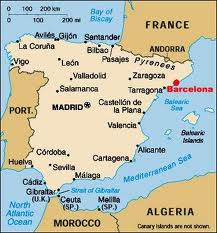
Barcelona is the capital of Catalonia and with +1.6 million people it is the second largest city in SpainThe Barcelona metro population is 5 million people, just like Atlanta.  Founded as a Roman city, it now seems that Barcelona is one big showcase for the architectural works of Antoni Gaudí.  The whole city has a unique vibe to it.

The main landmark is La Sagrada FamíliaIt's simply amazing!

La Rambla is the main pedestrian boulevard filled with restaurants, performance artists and vendors selling flowers, birds, lottery tickets, etc..  Along the sides are some very cool looking buildings.  This is also where you can find la Boqueria which is an awesome open market for fruit, mean, cheese, vegetables and lots of fresh seafood.  The tree-lined street is 1.2 km (0.75 mile) long and runs from the Gothic Quarter to Port Vell.  It gets very crowded so the best time to enjoy it is early in the morning.


At the end of Las Ramblas is the Columbus Monument.  It is 60 meters (197 feet) tall and was built in 1888.  It marks the location where Columbus returned to Spain after his first voyage to the Americas.

The Barri Gòtic is the center of old Barcelona.  Most of the buildings date from the 14th and 15th century although there are also some remnants of the Roman settlement.  The Cathedral of the Holy Cross and Saint Eulalia is the Gothic cathedral and the seat of the Archbishop of Barcelona.  Construction lasted from the 13th to the 15th century.  It is one of the country's greatest Gothic structures.

The Hospital of the Holy Cross and Saint Paul was built between 1901 and 1930.  It was a hospital until 2009 and it is currently undergoing restoration to be used as a museum and cultural center.  It is one of Barcelona's many UNESCO World Heritage Sites.

The Palau de la Música Catalana is a concert hall that was built between 1905 and 1908.  In 1997, it too was declared a UNESCO World Heritage Site but, unlike most of the other sites in Barcelona, Gaudí wasn't the architect.  It was designed by Catalan architect Lluís Domènech i Montaner.


The Triumphal Arch was built for the Universal Exposition in 1888.


The Park de la Ciudadella is a great place for a relaxing walk (or bike ride).  The gardens and fountains were designed by Gaudí.


The National Art Museum of Catalonia is housed in the Palau Nacional which was built for the World's Fair in 1929.  There is a 15 minute fountain show in front of the museum that runs every 30 minutes during Summer.  Lucky for us the weather was great and the fountain shows were already running.

The Olympic stadium at Montjuïc was completed in 1929.  It was intended to host an anti-fascist alternative to the 1936 Berlin Olympics but it never happened due to the Spanish Civil War.  However, it was finally used during the 1992 Olympics.  Wow!  Has it really been 20 years since the Barcelona Olympics?


As I wrote before, Barcelona really is a Gaudí showcase.  One of my favorite spots in the city was Park Güell, also another UNESCO World Heritage Site.  Originally it was supposed to be a private estate but instead it ended up as a public park in 1922.  There is a park bench in the shape of a serpent that is the longest bench in the world.  Park Güell is just so over the top wild that you can't help but enjoy it.

La Pedrera, formerly known as Casa Milà was built by Gaudí from 1905 to 1910.  The façade has a wave effect that is emphasized by elaborate balconies.  It was controversial at the time.  Heck, it would still be controversial today but it just looks so cool.  In 1984, it was added to the UNESCO list.


Casa Batlló was built in 1877.  The front has no straight lines.  It is also called the House of Bones because it has a skeletal feel to it.  It too is on the UNESCO list.

Here's a Rick Steves video from YouTube that does a far better job than I could ever do describing Gaudí's Barcelona.
©Rick Steves