Thursday, May 27, 2010

The Bone Church

The Bone Church is what everyone goes to Kutná Hora for. The ossuary is actually in Sedlec, a suburb of Kutná Hora, but that’s not important.


The place is pretty macabre. The small, Baroque, 14th century, Roman Catholic chapel is located on a cemetery. It is decorated entirely with human bones. Did I mention that it was macabre?

In 1511, a half-blind monk arranged human bones into pyramids. Later on in 1870, a woodcarver made very unique decorations. They then became a chandelier, crosses, goblets, monstrance and even a coat of arms. In addition, there is a bell-shaped stack of bones in each of the four corners. The artist even signed his name on the wall by the entrance. Of course, he did it in bones. It’s estimated that there are remains from over 40,000 people. All of the bones were disinfected before use.


The chandelier contains at least one of every bone in the human body.

In 1278, the Sedlec abbot was on a diplomatic mission in Jerusalem. When he left, he took a handful of earth from the Holy Land which he sprinkled over the cemetery in Sedlec. It became famous throughout central Europe and lots of wealthy people wanted to be buried here. The place was expanded during the Plague in the 14th century and during Hussite wars in the 15th century. So it’s not like people were killed just in order to decorate the church.

The purpose of the Bone Church is to remind all of us that human life is transient and that death is inevitable.

Wednesday, May 26, 2010

Kutná Hora, Czech Republic

Kutná Hora is a popular day trip destination for Prague tourists. It’s only 80 km (~50 miles) from Prague and about two hours from Brno. With only 22,000 inhabitants, it’s a very quiet village with some nifty sights.

The town was founded in 1142. In the 13th century, silver was discovered here and Kutná Hora became the second most important city in the Kingdom of Bohemia, competing with Prague economically, politically and culturally. In 1995, the city became a UNESCO World Heritage Site.

The Gothic Church of St. Barbara was started in 1388 and, more than 500 years later, it was completed in 1905. This is the country’s second largest cathedral, after St. Vitus. It is named after the patron saint of miners. Very important for a mining town. There are some outstanding late Gothic and Renaissance murals inside that date back to the 15th century.


The Baroque Jesuit College is right next to St. Barbara’s. Kind of neat to have Baroque and Gothic right next to each other. It was built between 1667 – 1703. In front of the college is a low wall with 13 sculptures of saints. It was designed to resemble the Charles Bridge in Prague.

Formerly known as the “Golden Comb House”, the Tyl House is the birthplace of Josef Kajetán Tyl. He was a writer and dramatist. He also wrote the words to the Czech national anthem. The house is now the Czech Museum of Silver.

Water was a tough commodity in Kutná Hora. The Late Gothic stone fountain was built in 1497. The second digit that looks like half of an "8", is how they used to write "4".

Across from the fountain is the Knights' House. This house is different from others in town because it was reconstructed in 1824 in the Classicist style.

The tower of St. James’ Church can be seen from almost everywhere in town. The original plans called for two towers but during construction it was discovered that the church’s base could only support a single tower.

Most major cities in Central Europe have a Plague Column. This one was built from 1713 – 1715 for the +6,000 people who died here. Since this was a mining town, the column contains sculptures of miners.

Most people take the trip to visit The Bone Church. I’ll post about that later.
I know this will sound crazy but one of the day’s highlights was visiting the café at Kozím Plácku. I had the best cup of coffee I’ve had in a year!! There are only two places in the entire country where you can get a vacuum pot, here and in Prague. I must find out where in Prague for when I’m back there in July. Basically, you pick the kind of coffee you want, Brazilian for me, and they put it in a contraption that looks like it came straight out of chemistry class. The hot water in the bottom part rises up to the top part and then the coffee settles back down. It was soooo good. Yes, the espressos are good here but this was real coffee.

Monday, May 24, 2010

2010 Hockey World Championships

This weekend concluded the 2010 World Championships for ice hockey. Hockey is a big deal over here. The Czechs won the title in 1996, 1999, 2000, 2001 and 2005. They also won another six titles as part of Czechoslovakia.

On Saturday afternoon, the Czechs beat Sweden 3-2, to make it to the finals against Russia. Sweden went on to beat Germany for the bronze medal. The Russians won the title in 2008 and 2009.

Well the Czechs pulled it out and beat Russia 2-1. It's pretty cool because Russia had some big name players and the Czech team was mainly guys who play here. I guess this helps make up for not getting a medal in Vancouver. Plus, the Czechs seem to enjoy it whenever they can stick it to Russia.
Everyone went crazy when the Czechs beat Russia. Lots of shouting, singing, and horn blowing. I'm sure that the bars were lively on Sunday night. I was happy that the Czechs won but I was over it a few hours later when I needed to sleep and I could still hear the horns at 2:30 AM.

Saturday, May 22, 2010

Bratislava Pride 2010

Today was Bratislava's 1st ever gay pride parade. Or at least it was supposed to be. The event seemed pretty well-organized and several foreign diplomats had even confirmed their attendance. I heard that between 500-1,000 people showed up.

Then about +80 neo-Nazis showed up to put an end to the festivities. According to the news, fascists threw rocks, eggs and a tear gas canister in to the crowd. And two people carring the rainbow flag were assulted and hit in the face. There were 200 police officers on duty and 29 people were arrested, many belonging to the ultra-right wing nationalist Slovenská Pospolitos party. Hasn't this part of the world already had enough of fascism?

In the lead up to Saturday, 17 different embassies, including the American Embassy, issued a joint statement supporting Bratislava's Gay Pride event.

Since the police were unable to guarantee everyone's safety, the parade was cancelled. Given that the pride parade had been planned out months in advance, and that foreign diplomats were going to be there, then it seems to me like the police should have planned things a little better. I wonder what it's going to be like when Brno has its pride festival next month?

Friday, May 21, 2010

Ingnis Brunensis 2010

Ingnis Brunensis started tonight. It's a festival that runs from May 21st - June 4th and the biggest attraction is the international fireworks competition. "Ingnis" is the Latin word for 'fire'.
This is the 13th year for the competition and companies from ČR, Slovakia, Germany and France will be competiting over the next couple of weeks. There will be six shows, all accompanied by music, and the best part is that they are all for free.

Tonight's kick-off was out at the Olympia shopping mall. The competition will be held at the Brno dam. I bet the reflection of the fireworks from the water will look pretty cool. The finale is going to be at Denis Gardens.

Other parts of the festival include hot air balloons, a children's day, an historical tram exhibition, a classic car show and a folk fest up at Špilberk castle. This festival is the largest event here in the ČR. Each year it attracts +1,000,000 people. Here's some video of tonight's prelude.

Wednesday, May 19, 2010

Government Business Hours

Czech government offices have the craziest business hours. Úřední hodiny are the hours open to the public and it makes me wonder, at times, how anything gets done around here.

On Mondays and Wednesdays, government offices are normally open from 8 AM - 5 PM. And if you're lucky then also until Noon on Fridays. But don't forget that the office will be closed for an hour during lunch time. So much for trying to run out and get something done during your lunch break.

Therefore, if you have to go to the foreign police, the land registry, the business registry, the tax office, the unemployment office, etc., then you need to do it on specific days.

I wonder if the bureaucracy is a hold over from communism? But it's been 20 years since the Velvet Revolution. I mean, seriously, what do the bureaucrats do during the rest of the week? None of my Czech friends have been able to tell me. They seem to wonder the exact same thing.

Tuesday, May 18, 2010

Frankfurt am Main, Germany

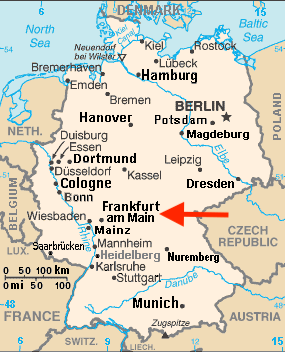
There is a small city called Frankfurt in eastern Germany. But when people say “Frankfurt” they are talking about the western city of Frankfurt am Main. It means Frankfurt on the Main (pronounced “Mine”) river.


It’s Germany’s 5th largest city and a major financial center. Sometimes it’s called “Mainhattan” because Frankfurt is home to the European Central Bank, the German Federal Bank, and the Frankfurt Stock Exchange, in addition to, +300 national & international banks.

Frankfurt was heavily damaged by allied bombers in WWII. Some things were rebuilt but overall, the city feels modern. Its many skyscrapers make it look like any other American city. Here are some of the weekend’s highlights…

St. Bartholomew’s Cathedral is the city’s main church. The Gothic building was constructed in the 14th and 15th centuries. From 1356 onwards, this is where the kings of the Holy Roman Empire were elected. From 1562 – 1792 this was where the roman-German emperors were crowned.


Paulskirche, St. Paul’s Church, was established as a Protestant church in 1789. In 1848, it was the seat of the first democratically elected Parliament. The church was partially destroyed during the war but was quickly rebuilt. It is no longer used for religious services but it used for exhibitions and city events.
The old opera house was built in 1880. Until the late 1970s, it still had not been rebuilt from the war and was nicknamed “Germany’s Most Beautiful Ruin”. Due to public pressure, the opera house was finally reconstructed and reopened in 1981. The inscription says: "Dem Wahren, Schönen, Guten” – “To the true, the beautiful, the good".

On Saturdays, there is a big flea market along the Main River. Lots of Germans, Poles, Turks and Russians all out selling everything from old records to clothes and from electronics to china. You could also see rowers practicing on the river and a free concert. This weekend was also the Smart Beach Volleyball tournament in the center of town. It was a busy Saturday!

The Römer is a medieval building and one of the city’s most important landmarks. It has been the city hall for over 600 years. In the Römer Square is a memorial to where Nazi students burned books in 1933.


The European Central Bank is responsible for monetary policy over the 16 Eurozone countries. There is even a Euro gift shop. With everything going on in Greece, plus Spain and Portugal, several newspapers had headlines this weekend questioning the Euro and if perhaps Germany needed to go back to using Deutsche marks.

Westendtower was completed in 1993 and is 208 meters (682 feet) tall making it the 3rd highest skyscraper in Frankfurt. The façade is made of fine, golden granite which makes it look whiter and brighter from afar. The building’s steel crown is heated in winter so that icicles can’t form which would endanger pedestrians below.

Maintower was completed in 1999 and at 200 meters (656 feet) is the city’s 4th tallest building. 
This was the first high-rise building in Europe to have a façade made entirely of glass. 

This is the only skyscraper with a public viewing observatory. For 5€ ($7.50), you can ride the speed elevator for 20 seconds and check out the 360° view from up on the roof.


Johann Wolfgang von Goethe was one of the key figures of German literature and author of the two-part drama Faust. For €5 you can visit the 17th century house where he was born. The museum was closed for renovations but the house was worth seeing.

The Frankfurt Jewish cemetery is the 2nd oldest in Germany. At the start of the 20th century there were ~7000 headstones. In 1942, the Nazis destroyed the cemetery and by the end of the war about 2/3rds of the headstones were destroyed. Only a small portion of the cemetery is still in the original condition. There are 11,134 small blocks placed on the cemetery walls, each one is engraved with the name of a Frankfurt Jew that was killed during the Holocaust. I know that there is a tablet with Anne Frank’s name but I didn’t see it.


Frankfurt even has dinosaurs out on the streets. Cool!

After a full day of sightseeing (and dinosaurs), nothing beats currywurst and ebbelwoi. Currywurst is a pork sausage, cut into slices, and seasoned with curry sauce and curry powder. Ebbelwoi is 5,5% - 7% apple wine with a tart, sour taste. It is refreshing in the summer and served hot in the winter.

The last time I was in Frankfurt was in 1992. The two obvious things I noticed were several new skyscrapers and fewer Americans than before. Frankfurt used to be the headquarters city for the U.S. Army in Germany. In addition, there were 7 air force bases (Hahn, Zweibrücken, Rhein-Main, Bitburg, Sembach, Spangdahlem and Ramstein) all within 100 km (62.5 miles). With the end of the Cold War, 4 of those bases have been closed. I had hoped to maybe find some American products while I was there but no luck. All I was able to find was a 16-piece pack of Oreo cookies. I guess it’s time to start hinting for another care package from home.