Sunday, January 10, 2010

Blue Church

I spent this weekend with my friend Martin who lives in Bratislava. I've been to Bratislava several times but never had much of an opportunity to really appreciate it before. Fortunately, Martin is a big history buff and can give one heck of a tour. So I finally got to see the "Blue Church".

The Church of Saint Elisabeth was built in 1907-1908 and is an Art Noveau, Hungarian Secessionist Catholic church in the eastern part of Old Town. It is decorated with bright blue majolica tiles. Majolica tile is manufactured in Modra, Western Slovakia.

The church is consecrated to Elisabeth of Thuringia. She was the daughter of Hungarian king Andrew II and whe was born in 1207 in Pressburg (now Bratislava). She was engaged to Ludwig IV when she was 4 years old and they were married when she was 13.

She was dedicated to helping the poor and the sick her entire life. She died when she was 24 and four years later she was canonized by the Pope. Today, Saint Elizabeth is the patron saint of Hesse and Thuringia in Germany, patron of charity circles, widows, orphans and the poor.

Elisabeth is best known for the legend which says that whilst she was taking bread to the poor, in secret, her husband asked her what she had in the basket. Elisabeth opened it and the bread she was taking had turned into roses. Click on the pictures to see them better.
I'm sure this church does a huge volume of weddings. Especially since it kind of looks like a wedding cake. The only bummer when we went is that it was locked so we couldn't see the inside. Oh well, that just means another visit.

Monday, January 4, 2010

Rahnsdorf, Germany

While in Berlin, we stayed in Rahnsdorf, with Claudia's family. There are 16 counties in Berlin and Rahnsdorf is in the easternmost district of Köpenick. It is near the water on the Müggelsee.

It is about 30-40 minutes to the center of Berlin.

It was cold when we got there but it wasn't too bad. Then came the snow. In two days we got over 40 cm (~16 inches) of snow. Everything was so pretty covered in snow. It looked like a winter wonderland.


I can't remember the last time I had to shovel snow. It had to have been at least 15 years ago. Claudia's parents live near the woods and it was perfect for sledding. The neighbors were nice enough to loan us a sled one afternoon and we hit the hills.


Claudia's family was awesome! Her parents only speak German but her sister Connie speaks English so we had an extra translator for Marcus. But he did start to pick up some German in just a few days.

Her dad is really interesting. I could listen to him for hours talk about history, economics and politics. And her mom is so sweet and can cook! She even sent us home with care packages filled with homemade preserves, green cabbage, potato salad, meatballs, sausages, honey, Rotkäppchen sparkling wine, and seasonings. I'm ready to go back for another visit soon.

Trabant

The Trabant, or “Trabi”, was the most common vehicle in East Germany. Its main selling point was that it had room for four adults, plus luggage, in a compact shell. More than 3 million cars were produced over almost 30 years and without any significant changes.

The usual waiting time for a Trabant was 15 years and it cost about a year’s salary. The average lifespan was 28 years and used Trabis would often fetch a higher price than new ones because a new one took so long to get.

The Trabant was made of Duroplast - plasticized cotton waste treated with resin. This didn’t really provide much in the way of crash protection but at least the government didn’t have to import expensive steel. So this was the first car with a body made out of recycled material, and then mounted on a metal frame. So no rust…just look after the chassis.

Here's an old East German commercial for the Trabi.


Some of the car’s challenges…
The two-cylinder engine ran on a mixture of oil and gas. To refuel you had to lift the hood, fill the tank with a maximum 24 liters (6 gallons), add two-stroke oil and shake it back and forth to mix.
There was no fuel gauge. But when the light went on for the reserve tank you had better get to a gas station quickly.
There were four speeds but it took a little while to get used to the column mounted gear change.

No brake lights or turn signals.

Not many driving comforts…the rear windows were glued shut, no carpeting, no glove box. But there was a heater…a fan would blow hot engine air into the interior, along with exhaust fumes.
There is even a Brno Trabi Car Club.


Sunday, January 3, 2010

The Berlin Wall & East Side Gallery

By 1961, 3.5 million East Germans, about 20% of the population, fled to the west. In order to prevent the "brain drain", of educated professionals and skilled workers, the government put up a concrete barrier that cut off East Germany from West Berlin.

The DDR's "Anti-Fascist Protection Wall" had one purpose and it wasn't to protect the East German capital from the West. It was to keep its citizens from escaping.

The wall ran from for 156 km (97 miles) around West Berlin and for 43 km (27) which actually divided West and East Berlin. The wall was built slightly inside of East Germany territory so that it did not encroach on West Berlin.

Here's a video that shows how the city was divided.

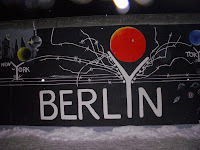
Most everyone knows that the west side of the Berlin Wall was decorated with murals and graffiti. Well after the Wall came down in 1989, artists were able to paint the eastside of the Wall that had been untouchable until that time.

Berlin's East Side Gallery is a 1.3 km long section of the wall near the center of Berlin. There are around 106 paintings making it the largest open air gallery in the world.


Update 2023:  Here's a 7-minute animated history of the Berlin Wall that I found on YouTube.

©Simple History

Saturday, January 2, 2010

DDR & Stasi Museums

East Germany's official name was the German Democratic Republic (Deutsche Demokratische Republic or DDR). Near the Berliner Dom, is the DDR Museum, an interactive museum, covering the DDR's 40 years.

There are around 600 objects on display and the focus is on what daily life was like in the DDR. Themes such as work, school, shopping, leisure, fashion, culture, etc. are all featured. There is a replica of a typical East German flat and even a Trabant, the national car, that you can sit in.

The DDR Museum was very interesting. Entrance is 5,50 € and everything is in both German and English.

The Ministerium für Staatssicherheit, or Stasi, was the East German secret police. It was one of the most effective and repressive agencies in the world. The Stasi motto was "Schild und Schwert der Partei" (Shield and Sword of the Party).

They infiltrated almost every aspect of East German life. It has been estimated that there was one informer for every seven citizens.


The Stasi Museum has some fascinating exhibits but everything is in German. One of the better exhibits shows the array of surveillance equipment used to spy on the population. Everything from miniature cameras concealed behind button holes to listening devices in fake rocks.

One of my favorite movies is Das Leben der Anderen (The Lives of Others). The movie shows to what lengths the government went to spy on its own citizens. There is one scene in the movie where an interrogator collects and preserves a scent sample from a prisoner in order to have it available for the dogs. There is even a display at the museum showing how they did this for real.

Here's the movie trailer for Das Leben der Anderen.


Update 2025:  Here's a short video I found on YouTube about the Stasi.

©History Matters

Checkpoint Charlie

Checkpoint Charlie was the most well-known Berlin Wall crossing point between West Germany and East Germany. As such, it was often featured in movies and spy novels.


For 28 years, from 1961 to 1990, Checkpoint Charlie stood at Friedrichstraße. It was the only border crossing point for the Allies, foreigners, employees of the Permanent Representation and officials of the DDR (German Democratic Republic/East Germany).


Checkpoint Charlie stayed open, after the Berlin Wall fell, until German reunification in 1990. The guard house was removed and is now on display at the Allied Museum.


A copy of the guard house and sign that used to be the border crossing is on display. The course of the former wall is now marked in the street by a line of cobblestones. The museum Haus am Checkpoint Charlie tells the history of the wall. The museum is very interesting but it was very crowded. Here's a video I found on YouTube that talks about the museum.


©Rick Steves

Friday, January 1, 2010

Berliner Dom

The Berliner Dom is a baroque cathedral and the largest church in Berlin. It was built between 1894 and 1905. It is located on an island in the Spree river.

The Berlin Cathedral is not a true cathedral since it has never been the seat of a Catholic bishop. The Berliner Dom is a Protestant church.
During the Second World War, the building was hit by a fire bomb which severely damaged much of the Cathedral. To protect what remained of the interior a temporary roof was installed between 1949 and 1953. In 1975 reconstruction began while restoration of the interior began in 1984.

East Germany didn't oppose reconstruction because financial support came from the German Protestant Church and the West German government. During reconstruction, the original design was simplified and reopened in 1993.

Brandenburger Tor

The Brandenburg Gate is considered one of Europe's most famous landmarks. It was commissioned as a sign of peace by King Frederick William II of Prussia, and build built from 1789 to 1791. It is the only surviving city gate and one of the main symbols of Berlin and Germany.

It is located west of the city center, in what was East Germany, about one block form the Reichstag. The Berlin Wall ran just west of the gate which kept West Berliners from it. East Germany's fortified death strip was on the other side which kept East Berliners from it. So the gate sat in no-man's land for decades.

The gate has six columns on each side, forming five passageways. On top fo the gate is the Quadriga - a chariot and four horses diven by Victoria, the Roman goddess of victory.

Napoleon took the Quadriga to Paris, as a spoil of war, after the 1806 Prussian defeat at the Battle of Jena-Auerstedt. It was returned to Berlin after Napolean's defeat in 1814 and the Purssian occupation of Paris.

The Brandenburg Gate survived World War II but was badly damaged. After the war, West and East Berlin worked together to restore it. East Germany renovated the Quadriga in 1990. In December 2000, $6 million was spent to privately refurbish it.

Reichstag

The Reichstag is one of Berlin's most historical landmarks. It is home to Germany's parliament - the Bundestag.

There was a need for a large parliamentary building in Berlin after the German Empire was founded in 1872. The imposing neo-renaissance building was built between 1884 and 1894. In 1916 the inscription Dem Deutschen Volke, To the German People, was added.
Much of the Reichstag was destroyed in a fire in 1933. The Nazis blamed communists and used the incident to take power. It was damaged again at the end of the war.

The building is about a block from the Brandenburger Tor and was closed in by the Berlin Wall. There was no use for the building during the Cold War because the East German government used its Palace of the Republic and West Germany's capital was in Bonn.
After unification, Germany moved the Bundestag from Bonn back to Berlin. Reconstruction started in 1995 and in 1999 the Reichstag was once again the seat of the German Parliament.

A glass dome was added over the plenary hall. It has a 360° view of the cityscape. The main hall can also be seen from the cupola and natural light from above radiates down to the parliament floor.

Free tours are given of the Reichstag. While waiting in line to enter, a guide came up and offered us a specal pass to enter the plenary hall. We were given a lecture in German on the building's history. It was very cool to sit inside parliament and to be able to do something most tourists don't get to.

2009 New Year's Eve

New Year's Eve was spent in Berlin. We started off at this great Indian restaurant on Oranienburger Straße. Later, we walked over to the front of the Reichstag which was the best spot for midnight.

We got to see the fireworks from all over the city. It was impressive and the shows went on for at least 30 minutes. But the trash left behind on all of the white snow looked horrible. However, the city had people out the next day cleaning everything up.

I heard that the Czechs in Brno went crazy with the fireworks too. I remember having fireworks as a kid in California. But now it's illegal to buy them in California (or Atlanta). So it's odd seeing people here with them. Of course, it was also odd for me to walk down the street with an open bottle of champagne without a problem. You just can't do that in the U.S.

The one thing I did miss was Kathy Griffin & Anderson Cooper live from Time Square.